

KMS event reference · About these guides
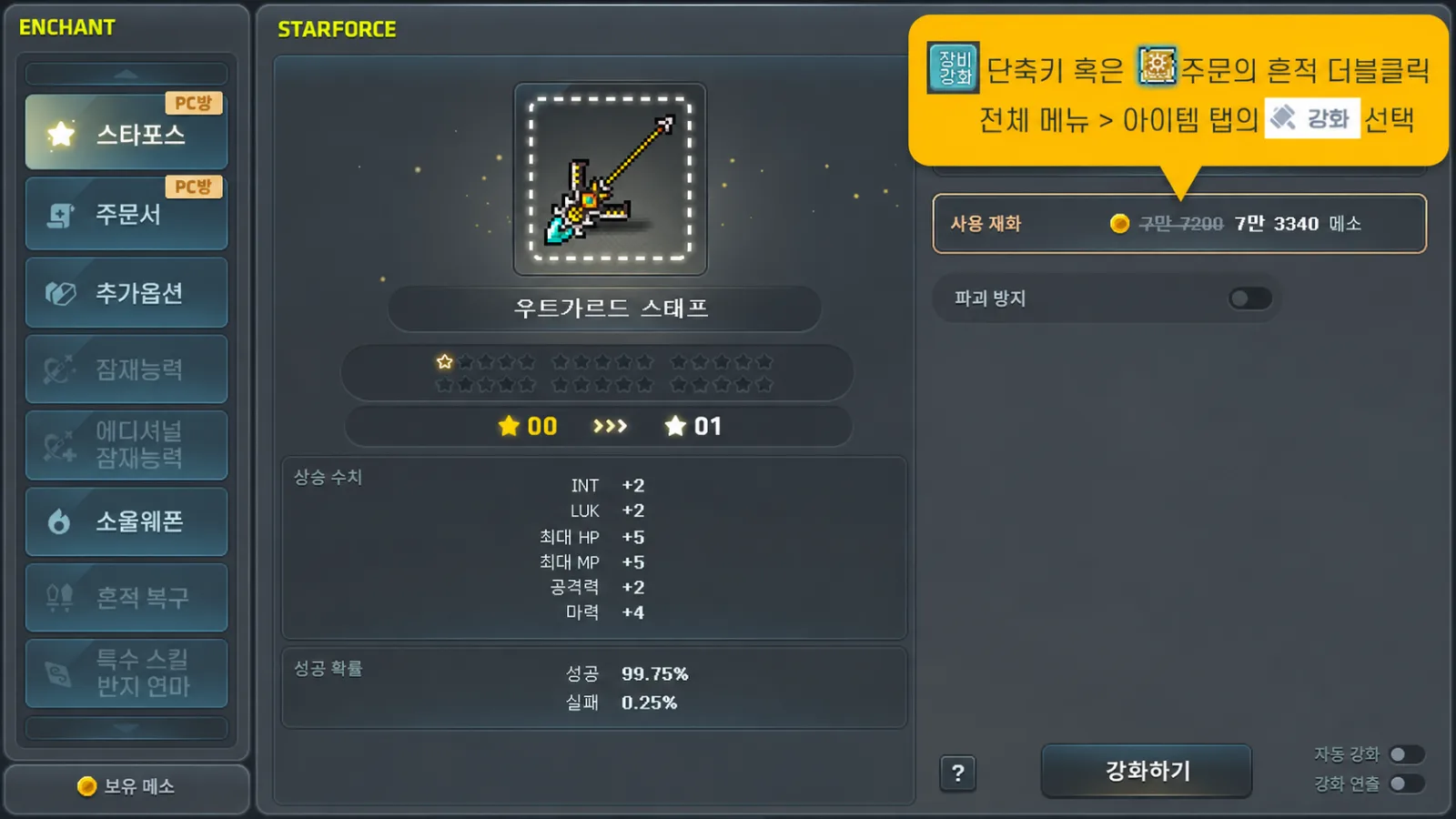
Shining Star Force is a popular time to plan a large equipment upgrade. The Korean source describes lower enhancement spending and reduced destruction-related costs during its event version.
That still does not make self-enhancing every item the right choice. Compare the target stars, item price, and replacement cost before spending.
This guide explains the Korean benefit example and how to compare enhancing, buying, and selling. Check the applicable event notice before using those benefits in a calculation.
The Korean Shining Star Force benefit example

The source's event version combines a lower Star Force cost with reduced destruction and trace-recovery costs.
Its listed benefits are:
- 30% off Star Force enhancement costs
- 30% lower destruction chance for attempts starting at 21 stars or below
- 20% off the applicable destroyed-item trace-recovery cost
- Superior equipment is excluded; the 30% cost discount does not apply to extra Safeguard mesos.
These benefits match the September 6, 2026 KMS event, which has ended; they are not a universal GMS event definition. The trace-recovery discount applied to mesos, with additional recovery charges above the base cost excluded for Astra secondary weapons and second-transcended Destiny weapons. Reduced destruction chance is not zero destruction chance. Include spare equipment and the applicable recovery method in the plan.
Prepare before enhancing
Choose the target first
Set a specific intermediate target, such as 18, 21, or 22 stars, appropriate to the item.
Without a stopping target, reaching the planned star can turn into another attempt. Repeated failure and destruction can leave the setup worse than intended. The exact post-failure and trace state depends on the regional rules.
With a limited budget, finishing useful intermediate targets on priority slots can be more practical than trying to make every piece 22-star at once.
Keep enhancement and recovery budgets separate
A discount changes cost, not certainty. Do not treat every available meso as an enhancement allowance.
For example, a 20-billion-meso budget could be divided among:
- The enhancement attempts themselves
- Spare or replacement items
- Trace recovery
- Mesos reserved for ordinary progression after the event
Set a spending limit that applies even if the target is unfinished. More attempts made only to recover a disappointing result can exceed the original plan quickly.
Check spare-item prices
For expensive Dawn, Pitched, or Eternal pieces, a destroyed item's replacement or recovery can matter as much as the attempt cost.
Before a destructive step, plan a usable spare or enough resources to obtain the appropriate replacement. Some recovery routes have their own item and meso requirements.
Enhancing versus buying finished equipment

When self-enhancing may fit
It can be worth comparing when:
- You already own the base item.
- Suitable spares are affordable.
- Finished candidates are scarce.
- The intended intermediate target fits the budget.
- The setup can remain usable after an unsuccessful session.
A favorable run can cost less than a finished listing. An unfavorable one can cost more. Neither outcome is guaranteed by the event discount.
When a finished item may fit better
Where equipment trading is allowed, a finished candidate can reduce uncertainty when:
- The base item is expensive.
- Recovery would be costly.
- A listing already has useful potentials and bonus stats.
- Your available mesos are limited.
- You need a completed 22-star setup by a firm date.
Include the base item, scrolling, Star Force work, and possible recovery when comparing self-enhancing with the listing. The apparently higher finished price may cover work you would otherwise still need to do.
Some finished items may be listed after an event, but that does not guarantee more supply or a lower price. Compare actual listings instead of relying on a predicted market move.
Trading considerations
Event expectations can affect prices
Compare recent completed transactions with current listings where those records are available. The event-day lowest listing alone does not establish value.
A higher base-item price can outweigh part of the enhancement discount.
Treat advance arrangements carefully
A privately arranged reservation can change its appeal if market prices move, and it can create disputes over delivery or terms. It is not necessary to use one to make an equipment plan.
Use the game's permitted trading systems and inspect stars, scroll work, bonus stats, main Potential, and Bonus Potential where applicable.
If selling, compare equivalent finished states
A raw base item and an item with completed scrolling or useful potentials are different products. Match the actual enhancement state when comparing listings.
A quick sale can be useful, but include what it would cost to replace the item if your progression still needs it.
A practical priority order
Prioritize equipment that gives a useful, lasting improvement rather than enhancing everything because an event is active.
First: long-term core equipment
Review the weapon and armor you intend to keep. Only some secondary weapons support Star Force; check the item rather than assuming every secondary can be enhanced. Potentials and bonus stats can also make a finished weapon the better candidate.
Second: affordable-to-replace slots
Several useful intermediate upgrades can fit a limited budget better than one expensive destructive attempt. Compare the actual damage improvement and recovery cost.
Third: expensive special equipment
Treat high-base-price Pitched pieces as a separate decision. Repeated destruction can add substantial replacement spending.
When to stop
Pause if any of these occur:
- The predetermined spending allowance is exhausted.
- You cannot fund the planned replacement route.
- Repeated destruction is compromising the usable setup.
- Total spending has already exceeded the finished candidate you compared.
- The next attempt is motivated only by wanting to undo the last result.
Previous failures do not guarantee the next attempt succeeds. Use the current enhancement screen's probability and any explicitly applicable regional mechanic; do not infer a hidden success guarantee from an unlucky streak.