
Korean raid-design commentary · About these guides
Every new Lost Ark raid brings a familiar discussion.
Players debate raid difficulty. The desired level depends on what the raid is for.
Some want top-end encounters to demand a serious effort. Others point out that excessive difficulty can become exhausting when the same content must be repeated weekly.
Korea’s Shadow Raid featuring Belgardin provides a useful example of that design tension. This article concerns its Korean introduction and historical event missions, not a North American release announcement.
The raid separated Normal, Hard, and Nightmare, with additional challenge objectives in the highest difficulty and the associated conquest event.
Why does “top-end raid” not simply mean making everything as difficult as possible?
Belgardin separated three difficulties
The second Korean Shadow Raid arrived on August 5, 2026.
It used an eight-player, two-gate format with these Korean item-level requirements.
| Difficulty | Required item level |
|---|---|
| Normal | 1750 |
| Hard | 1770 |
| Nightmare | 1780 |
The source describes Normal and Hard as targeting a level comparable to the preceding Serca content, with Nightmare providing a distinctly higher challenge. That is the source’s account of the intended comparison, not a controlled difficulty measurement.
The encounter also introduced a variation on the Korean Just Guard system: Holding Just Guard. This is a held-input timed guard; North American readers may know the related timed-blocking system as Perfect Block. Group mechanics also contributed to the encounter.
Difficulty therefore involved different execution demands rather than merely increased boss HP and damage.
Nightmare objectives went beyond a single clear

The associated Korean conquest event illustrated additional mastery goals.
Its objectives included cumulative clears, personal survival, and raid-wide conditions alongside a first Gate 2 clear.
Nightmare missions included survival by gate, pattern execution, and whole-raid conditions.
That made them closer to tests of pattern knowledge and coordinated execution than goals solved by gear alone.
This offers one way to interpret the design approach.
The highest difficulty can ask for more mastery without applying the same demands to every progression route.
HP and damage do not define all difficulty
Those are often the first numbers players think of.
Actual difficulty involves many other factors.
For example:
- Time needed to understand a pattern
- How one player’s mistake affects everyone else
- The frequency of lethal failure conditions
- Time between attempts
- Concentration required during the fight
- Assignment of raid roles
- How often the encounter is repeated after the first clear
A failed pattern can feel like learning if the next attempt is quick and the lesson clear.
If one mistake forces eight players to restart a long fight, perceived difficulty and fatigue can increase sharply.
The design question is therefore broader than how difficult an individual pattern is. Its surrounding structure matters too.
Does failure leave the group wanting another attempt? That is part of the experience being designed.
Individual execution and eight-player execution are different challenges
Belgardin uses an eight-player raid group.
One person understanding every mechanic does not guarantee a group clear.
A raid also depends on these factors.
- Survival across the group
- Mechanic execution
- Role assignment
- Response timing
- Coordination between players
Conditions requiring everyone alive or limiting mechanic failures can put more emphasis on the group’s overall consistency than any single player’s mastery.
The source points to Belgardin’s conquest objectives as an example.
The historical Nightmare Relic-title goals combined clear-related achievements with survival and group-execution conditions. They were not simply a repeat-clear counter.
Raising difficulty can therefore create a requirement that all eight players meet a demanding standard, rather than a challenge one person can solve alone.
A satisfying first clear and a satisfying weekly reclear are different goals
One defining feature of the discussion is
Lost Ark’s weekly repetition. The first attempt is only part of the design.
Several hours learning a new encounter can be enjoyable.
Repeating that encounter for many weeks changes the experience.
An initially tense pattern can become routine, while a restart from one mistake increasingly feels like lost time.
The difference can be greater for players maintaining multiple characters.
During the first clear, for example,
a hard pattern can be a challenge to master.
That is part of the appeal.
On a much later reclear,
the same pattern can become a source of additional repetition.
Its role in the experience has changed.
A raid designer needs to consider both the opening week and the weeks after mastery.
Progression rewards complicate difficulty choices
Raids are not only isolated tests of skill in Lost Ark.
Their rewards often feed character progression.
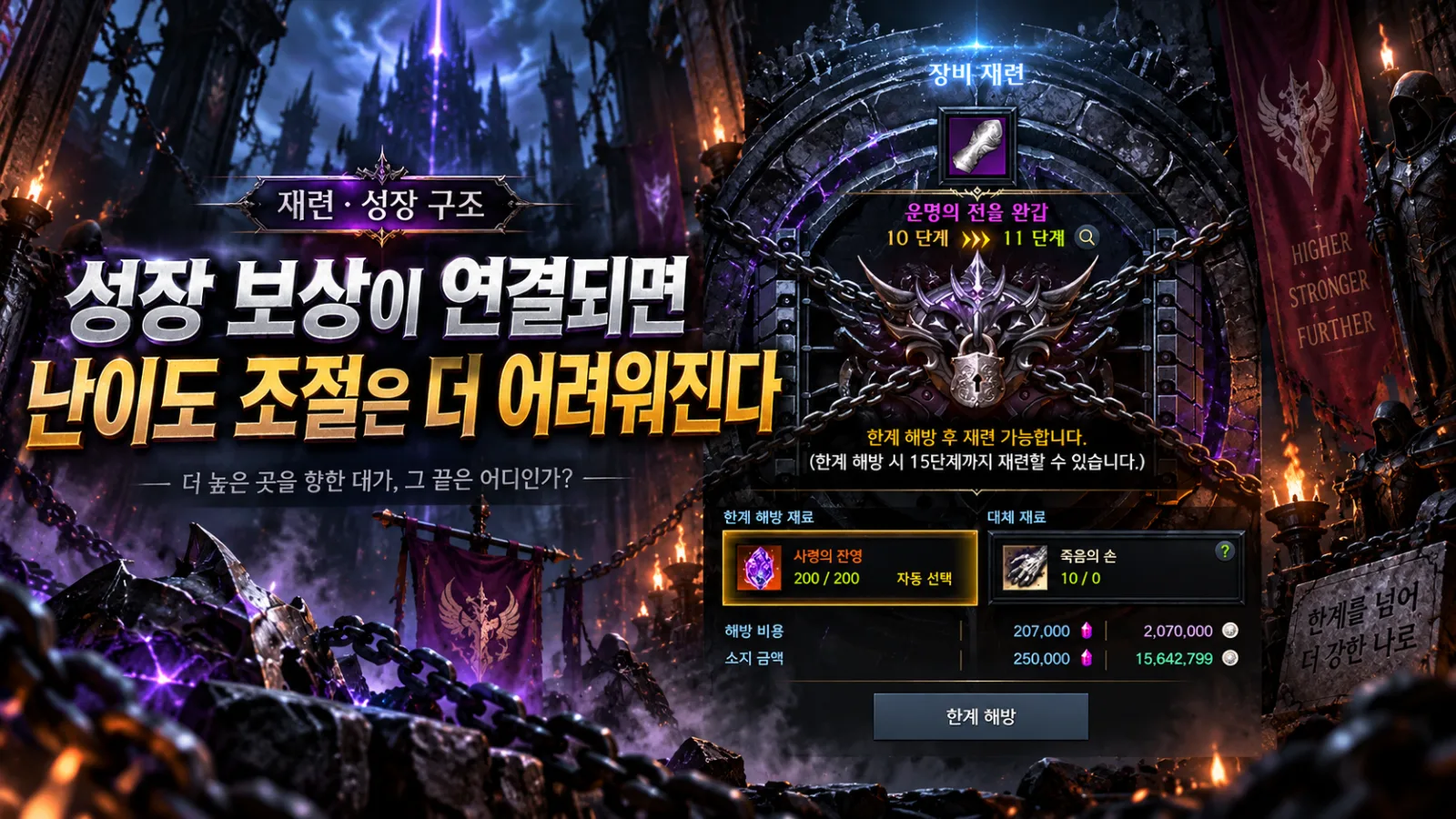
Belgardin also introduced the Korean equipment described here as an armguard. This is a separate system from bracelets; the term does not claim a verified Western release name.
The first Gate 2 clear awarded the initial armguard regardless of difficulty, with honing and limit breaks providing further progression.
Hard and Nightmare supplied materials needed for higher stages of that progression.
Making progression-linked content excessively difficult can create another problem.
Players who do not enjoy extreme challenges may still feel pushed to participate for power.
Routine progression content and prestige-focused challenges therefore need different difficulty considerations.
Would extremely hard content with only prestige rewards solve it?
Removing power rewards is one possible approach.
Possible rewards include:
- Titles
- Achievements
- Exclusive backgrounds
- Cosmetic rewards
- Records or rankings
These can let interested players opt into a challenge without directly gating ordinary character power.
The Korean Belgardin conquest event used prestige rewards such as a party-lounge background and Relic-grade title for its objective tracks. That event’s participation and claim windows have ended.
There is still a tradeoff.
Fewer progression rewards may also mean fewer participants, though this article does not provide participation data to measure that effect.
The purpose of the content needs to be clear first.
A weekly activity for a broad audience and an optional limit-testing challenge need different benchmarks.
Why multiple difficulties help
Several difficulties can offer different goals within the same encounter.
Belgardin used Normal, Hard, and Nightmare.
The potential division is straightforward.
Normal offers a route to experience the content.
Hard asks for greater progression and familiarity.
Nightmare provides a higher challenge.
That avoids imposing one level of difficulty on everyone while giving practiced players another target.
Multiple labels do not solve every problem by themselves.
If reward gaps are too large, the highest difficulty can feel required. If the gap offers too little motivation, fewer players may want the extra effort.
Reward balance needs to be considered alongside encounter demands.
Patterns need to be learnable
A good hard raid does not have to be defined by an inability to clear it at first.
The important question is what players learn through failure.
A useful pattern lets players identify something to change.
“I should have moved there.”
“I pressed the timed block too early.”
“We assigned the roles poorly.”
Each gives the next attempt a purpose.
Unclear failure causes or repeated blocks from other players’ mistakes can instead turn challenge into frustration.
What matters is a sense that repeated attempts improve the group’s play, rather than failure count alone.
What to examine in later raids
Belgardin’s separate difficulties offered both progression and a higher challenge.
Nightmare and the historical conquest missions added survival and coordinated-execution goals beyond raw gear.
For later encounters, look beyond a simple easy/hard label and ask:
- Does each difficulty have a clear purpose?
- Can repeated practice produce visible improvement?
- Are individual and group responsibilities balanced?
- Is it practical to try again after failure?
- Do higher-difficulty rewards create excessive pressure?
- Does the reclear experience remain reasonable after mastery?
A raid worth attempting again
Increasing boss HP and damage alone cannot solve Lost Ark’s difficulty-design problem.
Eight-player coordination, weekly repetition, and progression rewards interact as demands rise.
Separating difficulties and adding highest-tier completion goals is one possible response to that tension.
Top-end players need meaningful challenges, while regular participants also need a rewarding process of learning and progressing.
A good raid does more than produce failures.
It helps players see the next adjustment and want to try again.