

The key to Darius’s patch 26.21 buff is the wait for the next Q, rather than the damage of one cast. At maximum rank, its cooldown drops from 5 to 4 seconds. Another axe swing can mean another heal, more Hemorrhage stacks, and a stronger ultimate finish, so this change matters beyond a single line of numbers.
The useful question is how often you can land a second or third Q, rather than how hard the first one hits. Players comfortable in extended fights benefit, but it does not suddenly solve matchups where Darius cannot stay in range.
What exactly changed for Darius’s Q?
The change in patch 26.21 is the cooldown of Q Decimate. Here's a comparison between the old and new versions from Data Dragon, the official game data:
| Q Skill Level | Before change | After change |
|---|---|---|
| Level 1 | 9 seconds | 9 seconds |
| Level 2 | 8 seconds | 7.75 seconds |
| Level 3 | 7 seconds | 6.5 seconds |
| Level 4 | 6 seconds | 5.25 seconds |
| Level 5 | 5 seconds | 4 seconds |
In the official patch notes, the values after the change are written as 9/8/7/6/4 seconds, so there is a notation difference in the intermediate steps. Here I used official game data that provides step-by-step figures. In both cases, the change in maximum level from 5 seconds to 4 seconds is the same.
If you raise Q all the way first, you can take advantage of the largest decrease at champion level 9, according to general skill investment rules. This doesn't mean there are no changes before level 9. Level 1 Q remains the same, but from level 2 onwards, the waiting time gradually gets shorter.
This change does not include any increase in Q damage or recovery rate. It's not that the rewards get bigger when you get it right once, but the opportunity to get the same rewards again comes sooner. So, rather than seeing that all confrontations are overturned from the beginning, it is more accurate to understand that the value increases as Q's skill level increases and the engagement lasts longer.
How much more often can a four-second Q be used?
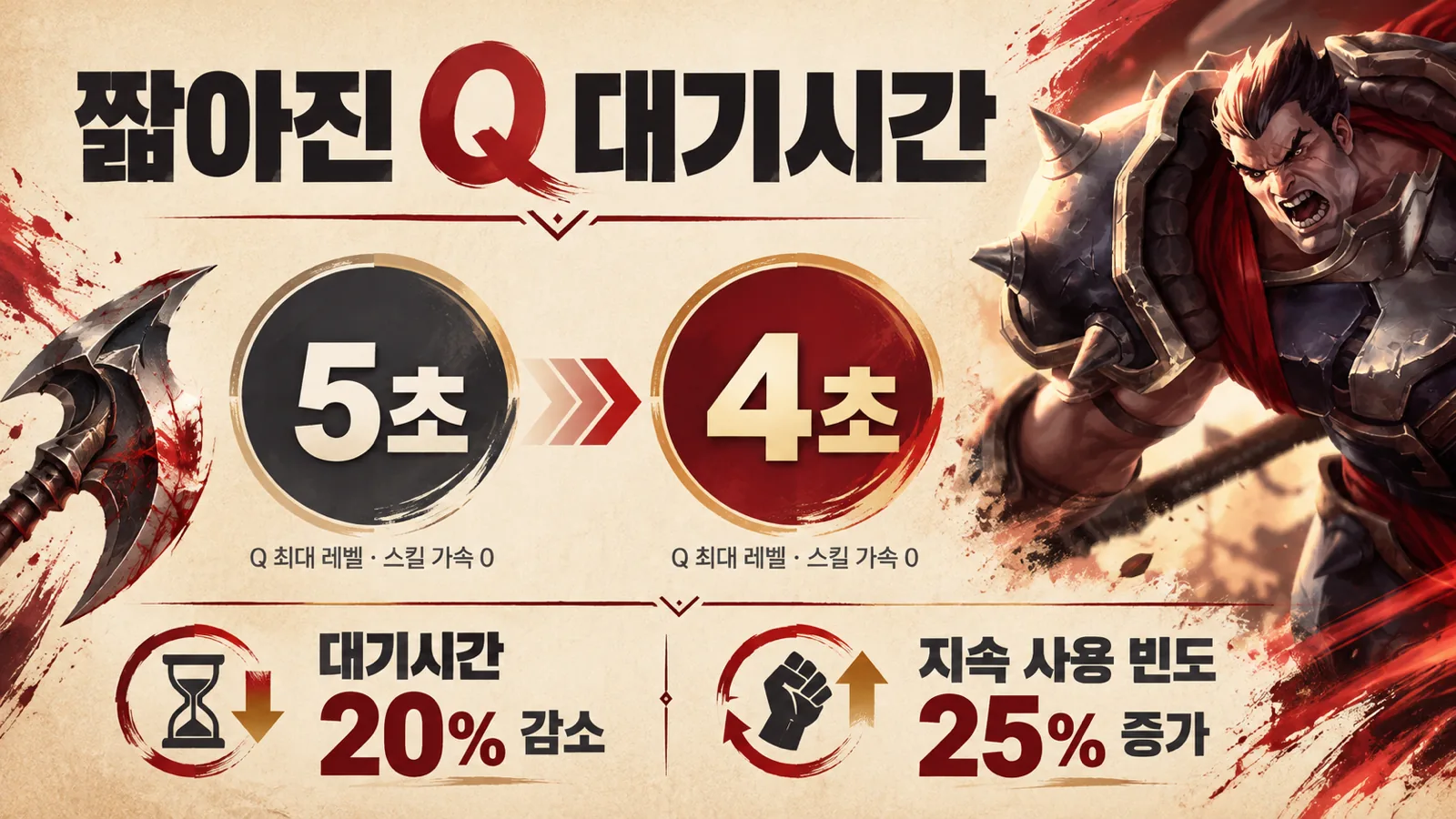
When reducing from 5 seconds to 4 seconds, the waiting time is reduced by 20%. However, assuming that it can be used continuously, the frequency of use increases by 25%. Previously, it was once every 5 seconds, and after the change, it was once every 4 seconds, so the ratio of the number of times it returns in the same time is 5÷4.
It is difficult to read ‘increase in frequency of use by 25%’ here as ‘increase in total damage by 25%’. In actual combat, basic attacks and other skills are mixed, and even if Q returns, it cannot hit the opponent if he or she is out of range. If the engagement ends early, you may not get the benefit of the next Q being faster.
If you include ability haste, the difference in seconds will be slightly different. The calculation formula is ‘Basic cooldown × 100 ÷ (100 + ability haste)’. For example, if your skill haste is 20, your maximum level Q will be reduced from approximately 4.17 seconds to 3.33 seconds. Even though the reduction rate is the same, the actual reduction time is about 0.83 seconds. This example is not a recommendation that you must buy a specific item, but rather a calculation showing how to read the cooldown.
For Darius, that brief difference is significant. If you have little health left and are knocked out right before Q returns, the possibility of recovering from the next ax blade will disappear as well. However, it does not solve the situation where you die from an opponent's attack before using the faster Q. You must be alive up to that point to receive the buff rewards.
Q combines damage and healing
Decimate deals damage in a circular area, but the results are different for the ax blade and the hilt. Enemies hit by the outer ax blade take more damage, and Darius recovers health when he hits an enemy champion or large monster with the ax blade. Hitting an enemy champion with an axe's blade also grants stacks of Hemorrhage.
Therefore, if you view the effect of Q returning quickly as simply increasing the number of attacks, it is easy to miss the point. This is a change that reduces the opponent's health while increasing the opportunity to regain one's own health. The flow of holding on through recovery and attacking again during the remaining time fits well with Darius' long engagement.
In the previous patch 25.14, the proportional recovery amount of Q's lost health was increased from 15/30/45% to 17/34/51% depending on the number of targets hit. This time, the recovery rate was not increased again, but skills with recovery were reused more quickly. Since it is calculated based on lost health, it should not be understood as a certain percentage of maximum health being filled every time.
The important condition is still hitting the ax blade. If the opponent digs in and gets hit by the ax handle, or goes outside and avoids Q, they won't get the recovery and stacks they were expecting. This is why the movement to properly hit one hit is as important as increasing the number of times. Just because the cooldown is shorter doesn't mean it's easier to control distance.
Plan beyond the first lane trade
The buff may not be noticeable in short exchanges where Q is used and each person immediately retreats. The damage of the first Q did not increase with this patch. On the other hand, if you continue the fight by mixing basic attacks and W, and Q returns when the opponent approaches again, there is room to take advantage of the shortened waiting time.
But the answer is not to press Q every time you can. If you hit the minions together, the wave status changes, and if you only consume Q without hitting the opponent, the options for the next exchange are reduced. You also need to check your mana. Preparing a skill quickly and whether it is a good decision to use it every time are two different issues.
You must also look at the opponent's movement and defense skills. If the opponent has left a means to stick to the inside, it may be difficult to hit the outside ax blade even if Q is prepared. On the other hand, if the opponent has used a move, it will be relatively easy to plan the hit of the next Q. The difference here comes from what skills each player has left, rather than the compatibility determined by the name of the champion alone.
When checking directly, it is best not to simply look at whether a solo kill occurred. In the same progression, you can see the change better by looking at how many times Q is prepared in one engagement, how many times you hit with an ax blade, and how much unnecessary damage you take while waiting for the next Q. It is a more useful standard than judging the size of the buff based on just one game that happened to progress significantly.
In teamfights, find a target and an escape route

Riot's stated upward intention is to make the ax swing more often in long-lasting fights. It can be seen as a change from a trend that focuses on momentary skill linking to a warrior who endures and continuously threatens.
If this is the direction, the first thing to think about in a team fight is whether you can secure survival time by hitting Q on an enemy that can actually attack, rather than unconditionally chasing the distant carry. Hemorrhage stacks up to 5 times, and when the maximum stack is reached, attack power increases significantly. The ultimate damage increases depending on the target's bleeding stack, so creating time to continue the attack is linked to the finishing power.
Of course, this does not mean that hitting the nearest enemy first is always the right choice. If your ally has made an entrance or the opponent's key carry has already entered range, you should seize the opportunity to defeat it quickly. However, in a situation where you are chasing an inaccessible target for a long time and cannot hit Q properly, the reduced cooldown is unlikely to lead to results.
The same criteria can be applied when judging items. You don't just need to add attack power or ability haste, you also need to look at whether you need health and resistance to last until the next Q, and a way to maintain distance from your opponent. This is why it is difficult to say that a specific build is absolutely correct based on just one patch. If you increase the turnover rate in a battle that is already difficult to survive, you may end up without being able to use your prepared skills.
The buff does not remove Darius’s weaknesses
This time, there is no new rush or an increase in the range of E, Apprehend. The structure where Darius becomes frustrated when the opponent attacks from a wide distance and the ally does not have an opportunity to approach remains. Q is a skill that attacks the area around you, so even if the cooldown is short, you must first reach the effective range.
The opponent must be aware that the opportunity to attack after Q is removed is shortened. If you continue attacking with a 5-second sense of your previous max level, you may be exposed to the next Q. On the other hand, the default cooldown time for level 1 Q remains the same, so you don't need to think that all timing has changed from the start of the game. Skill level and ability haste must be considered together.
Healing reduction and crowd control also affect endurance through healing. Even if Q is ready, if the action is blocked before hitting or the recovery efficiency is low, the expected survivability may not be achieved. It is necessary to distinguish between the explanation that the opportunity for recovery increases and the guarantee that it will remain stable.
This buff alone does not establish that Darius has no bad matchups or is definitively top tier. Even win-rate comparisons require the same region, rank bracket, role, and sample conditions. Comparing unrelated samples and attributing the whole difference to the buff mixes champion changes with changes in who is playing.
The reason to pick him still depends on landing Q
The Darius 26.21 buff is especially welcome for those who know how to utilize existing strengths. Q There are rewards attached to the flow of raising skill levels, hitting the ax blade, and surviving until the next use. If you like to design long melee encounters, there's plenty of reason to reconsider your choices.
Do not stop at “one second less must mean he is stronger.” Ask whether that second actually creates another attack opportunity: are you alive when Q returns, is a target within blade range, and can you use the spell then? Those three conditions determine its practical value.
