

It is clear why I bought Rylai’s first as a Swain supporter. By adding a slowdown to the ultimate's continuous damage, you can prevent your opponent from escaping easily and give your allies time to attack. Runes strengthen short exchanges centered on Electrocute, and items are easy to understand if you approach them by selecting whichever you need between Liandry and Zhonya after Rylai’s.
However, the most important thing in this combination is the time to survive next to the opponent rather than the amount of damage. Increasing your health with soul fragments does not make you a tank from the start, and having a slowdown does not prevent you from escaping. Swain's strengths lead to the team's benefit when you choose the right opponent to take on and the order in which you go in.
Why Swain support starts with Rylai’s
Rylai’s Crystal Scepter is an item that slows enemies by 30% for 1 second when damaging them with a skill. It provides 65 spell power and 400 health and costs 2,600 gold. Swain continuously deals damage to nearby enemies with Demonic Ascension, so he can continuously apply slowdown to enemies within range.
The reason this effect is important is because it is connected to the maintenance conditions of the ultimate skill. Swain replenishes his demonic energy by draining life from enemy champions. If enemies remain within range, the transformation can be maintained for a long time, but if all enemies leave, the energy is depleted. Just holding on to a minion does not provide the same sustain effect as grabbing an enemy champion.
Here, Rylai’s makes the fight easier after completing the approach. It slows down the movement of enemies trying to walk away, and creates room for additional attacks from allies and Swain's next E. The longer you hold on to an enemy, the more opportunities you have to deal damage with your ultimate and Q. It is meaningful to supporters in that they can secure effects that are helpful to their allies with limited gold.
On the contrary, it does not solve the problem of first access. Since slowing is not a restraint, it is possible to respond by blinking or moving to increase the distance. If you turn on your ultimate and walk towards an enemy that is keeping you in check from afar, you may lose health before you even get close enough. It is more accurate to understand Rylai’s as ‘a tool that becomes advantageous once attached.’
Electrocute runes and your intended trades
Electrocute is a good fit if you want to briefly reduce the health of an opponent caught with E by connecting W and Q. It's about turning a single capture into a powerful exchange. The configuration can be done as follows.
| Division | Select | Expected Role |
|---|---|---|
| Key Rune | Electrocute | Additional damage when successively hitting individual attacks or skills |
| Domination sub-rune | Cheap Shot | Reinforcement when dealing follow-up damage to an opponent whose movement was interrupted |
| Domination sub-rune | Grisly Mementos | Securing accessories acceleration through defeat engagement |
| Domination sub-rune | Ultimate Hunter | Prepare for the next engagement with ultimate acceleration |
| Auxiliary Resolve | Bone Plating, Revitalize | Reduce the burden of continuous attacks and enhance recovery effects |
Electrocute has the condition of hitting the same champion with three individual attacks or skills within 3 seconds. Therefore, it is important to not think that all damage is done just by hitting E, but to look at the location of allies and connect to follow-up skills. It is also good to distinguish that Grisly Mementos is not a rune that reduces ultimate waiting time, but a rune that helps use accessories.
Bone Plating is suitable for situations where the opponent makes consecutive attacks at once. On the other hand, if Bone Plating is lost first in a long-range attack and then a full-scale engagement begins, its value may be lowered. For such opponents, you can also choose to supplement the recovery of health after the check with Wind of Regeneration. The ability fragments use ability haste and adaptive abilities as a starting point, and the last one can be selected depending on whether early survival is urgent or progression health is needed.
If you are sure of a long-term fighting structure, you can also consider Conqueror. However, if the opponent escapes before stacking up or Swain falls first, it is difficult to take advantage of the long fight. Rather than saying that one of Electrocute and Conqueror is always superior, the criteria for selection is the exchange method that can actually be made at the bottom.
If you add ignition to blink, the summoner spell can be used to power up the finish after capture. If you have a combination that needs to protect your ADC while blocking the opponent's entry, exhaustion is also worth considering. You don't have to give up your protection choices just because you choose an aggressive champion.
After Rylai’s, solve your survivability problem

Start with the support quest items World Map Book and Potion, and aim for Rylai’s as the first major completion item. However, if you are constantly being checked or cannot use the E angle due to your lack of movement speed, it is better to prepare shoes in the middle first. If you only memorize the order of completed items, it is easy to miss the gold you have and the immediate line situation when you return.
In the final selection of support items, Zazak's World Thorn is an aggressive choice that adds additional magic damage to skill hits. There is also a role to play when engaging from afar with W or initiating an exchange with E. Conversely, if withstanding a concentrated attack comes first, you can consider a defensive option like Heavenly Objection. Just look at whether you need more damage or survival in the next engagement.
After Rylai’s, consider Liandry’s Torment if you can survive and fight, and Zhonya’s Hourglass if you need to pass on one of the enemy’s main attacks. Liandry adds burns to her skill damage and gains additional damage as she continues to fight enemy champions, so she matches up with Swain, who deals constant area damage. Especially when engaging in a long fight with an opponent with a lot of health, the reason for choosing it becomes clear.
It is important that Zhonya can respond to concentrated attacks with his defense and use effects. However, while stiff, you cannot move or use skills on your own, so if you use it deep in enemy territory, you may be caught again after it ends. You should think of it as a way to overcome dangerous attacks from a position where your allies can follow you. Liandry and Zhonya cost 3,000 gold and 3,250 gold respectively, so they are not a light investment for a supporter.
There is no need to fix the shoes as Sorcerer’s Shoes. If you can afford a damage boost, look into Sorcerer’s Shoes, or if you're going to be defeated by basic attacks or crowd control first, look into defensive shoes that match that threat. For opponents with strong healing, consider Oblivion Orb and Morellonomicon, but it is better to check when healing reduction is needed and whether allies have it. Don't miss out on an important fight by waiting until you've decided on the fourth item.
Connect E and W at the pull destination
Swain’s E, Nevermove, detonates when its returning wave first hits an enemy, rooting nearby targets. If it roots a champion, you can recast it to pull them. Besides the initial aim, pay attention to what the projectile will hit first on its return path. If minions intercept it before it can reach your intended champion, apparently being in range may not be enough.
The basic connection can be understood as ‘Bound E → W at the location to be pulled → Reuse E → Q’. W is not a skill that explodes as soon as it is designated, but takes time, so it is important to set it up in advance where the opponent will be placed after being dragged, rather than where he or she is currently standing. W hits not only deal damage and slows, but also earn Soul Fragments.
Q deals additional damage if multiple lightning bolts hit the same opponent. The closer you use it, the easier it is to hit multiple branches, but there is no need to blindly walk forward to increase damage. If you are prepared for the opponent's ADC attack and the supporter's counterattack, it may be better to take advantage with only E and W and maintain your distance. Combos must be completed within a range that can be safely connected.
Skill investment also matches the role. If you are a supporter who frequently creates capture opportunities, you can consider strengthening E first, and if you are in charge of repeated melee damage exchanges, the investment value of Q increases. In the beginning, see opportunities with E and secure Q and W, but when the level rises, choose the next skill depending on whether you want to fight immediately and how much mana you have. The ultimate skill is first raised to the level at which it can be learned.
It is easy for the opponent to counterattack immediately after missing E. Considering that Swain doesn't have a mobility spell that can immediately increase the distance, it's a good idea to reduce the habit of maintaining the same forward position until the next E returns.
Your ultimate can last longer when you follow the engage
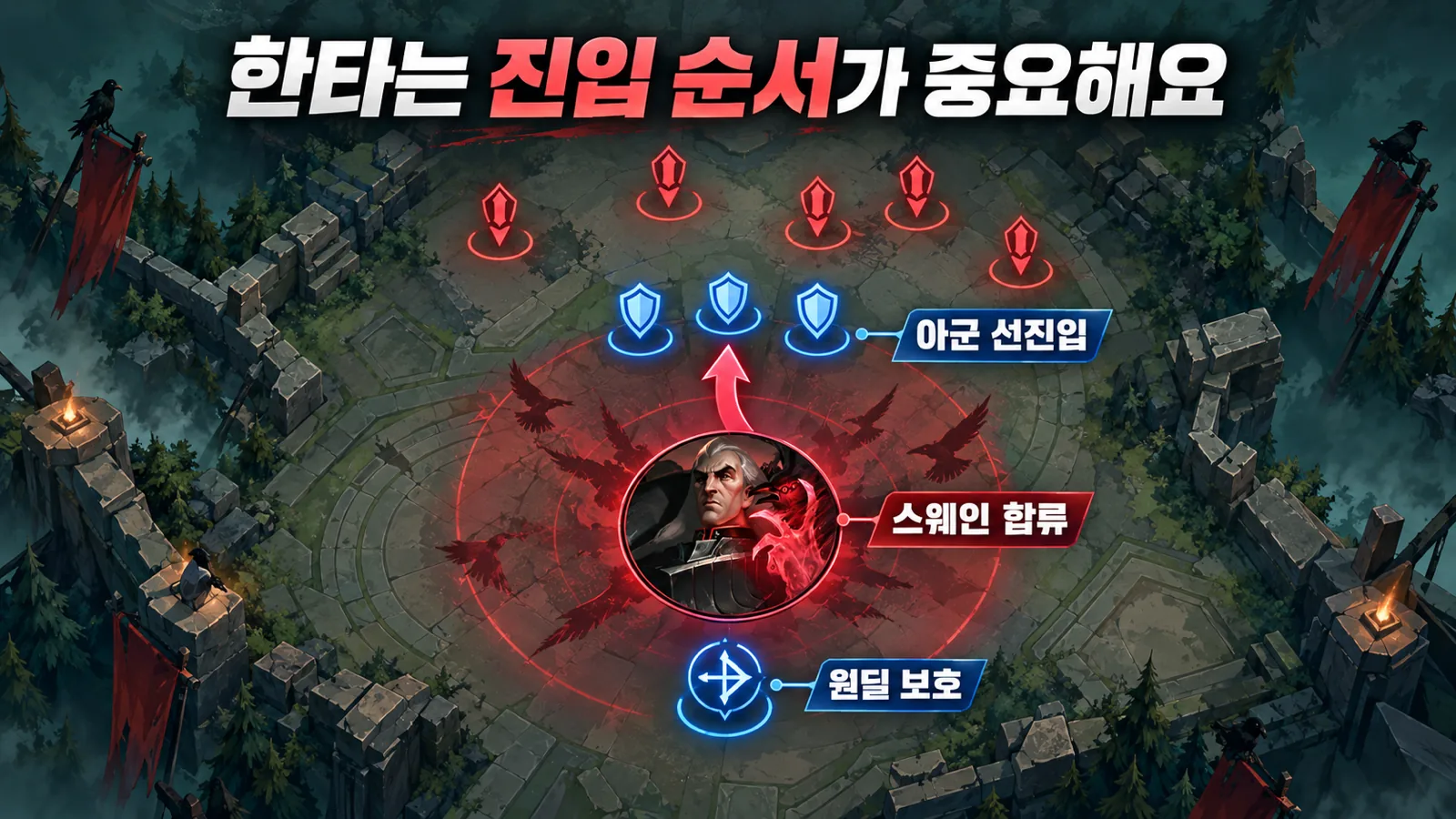
Soul fragments increase maximum health, but they do not solve defense and magic resistance at the same time. So, when evaluating a Swain support, I think it is more important to consider ‘what kind of attack can you enter after missing the opponent’s attack’ rather than ‘how many hits can you take’. To recover, you have to stay alive and continue absorbing, but if you get knocked down by the first concentrated attack, you don't have time to take advantage of continuous combat.
If your front line engages first and joins when the opponent's important crowd-control ability is missing, it becomes easier to keep the enemy within range of the ultimate. Here, second entry does not necessarily mean entering late. If your ally is already isolated or the enemy has stuck to your ADC, you need to decide to activate your ultimate on the spot and interrupt the attack with E and slow.
After turning on the ultimate skill, you must also take care to reuse Demonflare. When it can be used again during transformation, it can inflict additional damage and slow down those around it, and the transformation does not end immediately after using it once. Rather than just continuing to walk, it is good to use it when the opponent is about to get out of range to connect the next skill.
You must also choose what to chase. Rather than pursuing the enemy ADC deeply and getting further away from your allies, it is often more stable to keep the opponent attached to your ADC within range and deal with them together. Even though Swain's health recovery is noticeable, the purpose of the engagement is not to last long alone. You must maintain a structure that allows your allies to attack safely.
Judge lane partners and matchups by how fights connect
I can think of a structure where Jhin connects additional restraints after capturing Swain, and Caitlyn can think of a structure where she pressures the tied opponent with traps and range. Kai'Sa can coordinate her actions by quickly launching a follow-up attack against an opponent under crowd control. However, rather than thinking that the compatibility is complete just by looking at the champion name, you should first check whether your ally will actually attack you when you hit E.
On the other hand, it can be tricky for opponents who use a combination of reducing health from a distance and falling back, avoiding E with a mobility spell, or going out of range of the ultimate. You also have to be careful of opponents who, like Blitzcrank, draw Swain in when he doesn't want them to. The fact that Swain is a champion with a grab and the judgment that it is okay to hit an opponent's grab are two different things. Rather than memorizing counters in a single order, it is more helpful to check whether your operation is interrupted at any moment.
Outside the bottom, W's long range is useful. It can be used to assist allies with crowd control, or to check a point around an object before approaching it. However, one W does not make the entire path safe. The support role of managing vision with wards and lenses and checking the location of allies remains.
The criteria for selecting a Rylai’s Swain support is ultimately clear. It's about seeing whether our team can catch or receive it first, and whether there's room to join the fight and tie down the opponent for a long time. If you can increase your ally's attack time through slowdown and recovery, rather than just connecting E hits with the desire to kill, you can really take advantage of this build.
