

Seen a Super charge without a hit, or a Brawler cross water others cannot? One explanation is a Brawler’s Trait.
Traits are built-in passive abilities. They can change Super charge conditions or add distinctive movement and attack effects. Knowing yours helps you decide where to stand and what to do when no shot is available. Traits themselves are not abilities unlocked at a particular Power Level.
The category names below are descriptive labels for finding effects, and the listed Brawlers are examples rather than an exhaustive roster.
Traits Versus Star Powers
A Trait belongs to a Brawler’s base kit. A Star Power is a separate additional effect. Similar outcomes do not mean the underlying ability belongs to the same category.
For example, check whether starting with a Super comes from a Trait or a Star Power. The source identifies Surge’s starting-Super effect as a Star Power. Grouping every similar effect as one Trait can misrepresent the loadout.
For help choosing what to practice, see how to choose Brawlers by map, matchup, and upgrade priorities (Korean edition) as well.
Common Trait Categories
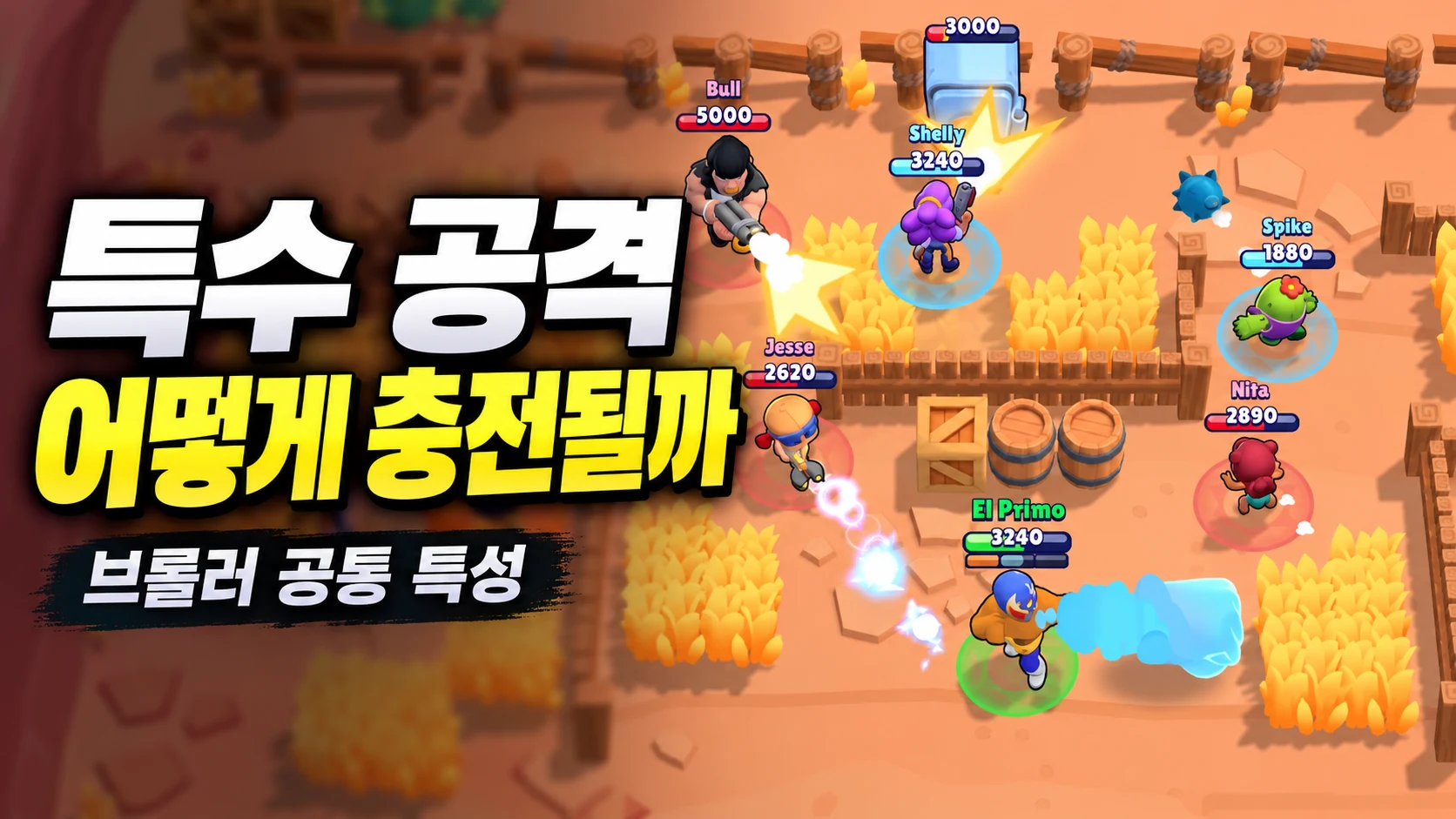
When examining Super charge, ask what action actually fills the meter. Taking damage, waiting, and approaching enemies lead to different decisions.
| Effect | Example Brawlers | First Check |
|---|---|---|
| Super charge from damage taken | Bull, El Primo, Rosa, Jacky, Frank | Health remaining alongside Super progress |
| Movement over water | Eve, Angelo, Shade, Wendy | Water routes for approach and retreat |
| Super charge over time | Darryl, Edgar, Kit | Your plan before and after charging |
| Super charge near enemies | Buzz, Cordelius, Lily, Shade | Distance and the charge radius |
| Super charge from healing | Berry, Doug | Who needs healing and which healing qualifies |
| Super charge while moving | Bolt; older Max guides require a version and loadout check | Check whether movement charge is a built-in Trait or an older loadout effect |
| Starting the match with a charged Super | Sam, Chuck | Match-start versus respawn behavior |
Charge rates and exact conditions vary by Brawler and can change in updates.
Using Damage-Taken and Healing Charge
Weigh health lost against charge gained. A nearly full meter is little help if you cannot survive the approach. Ask whether you can live through the damage and use the resulting Super safely.
For healing-based charge, allied health helps determine your next action. Support a teammate who needs healing rather than waiting only for offensive opportunities. Berry can build Super through both damage and healing.
Proximity and Water Movement Start With Positioning
Proximity charge makes distance relevant even when you cannot attack directly. On maps with walls, check the charge radius and approach route before exposing yourself. Use cover to prepare a future entry.
Water movement opens routes unavailable to other Brawlers, but it does not make enemy attacks harmless. Check cover on the far side and the opposing attack range before crossing.
Distinctive Brawler Traits

Traits can also affect damage, speed, or progression. These examples illustrate how they change decisions beyond ordinary Super charging.
| Brawler | Effect |
|---|---|
| Pearl | Damage increases with Heat. |
| Bolt | Builds movement speed while moving. |
| Buster | Charges Super near allies. |
| Clancy | Earns tokens by landing abilities and advances through stages. |
| Alli | Gains movement speed when pursuing low-health enemies under the required conditions. |
| Gigi | Charges Super near enemy projectiles or melee attacks. |
| Chester | Receives a randomly selected Super from several possibilities. |
| Kenji | Heals through attacks that damage enemies. |
| Wendy | Charges Super when her shield takes damage. |
These are examples, not a count of every Trait in the game.
Buster and Buzz Charge Near Different Targets
Both care about proximity, but Buster charges near allies while Buzz charges near enemies. Watch your team’s positioning with Buster and enemy distance with Buzz.
Do not remember only ‘charges nearby.’ Remember near whom, which is the distinction that matters during a match.
Wendy: Watch Shield Damage
Wendy can cross water, and shield damage contributes to her Super. Distinguish damage to the shield from ordinary health loss. Watch both displays while practicing.
Check Traits After Updates

Chuck is a key example when reading old guides. The August 2026 update removed his automatic Super charge and changed him to start the match with a fully charged Super.
Respawning is different. If Chuck already had a fully charged Super, he retains it on respawn; if he spent it, he does not receive a fresh full charge every time. ‘Charged at match start’ is not ‘charged on every respawn.’
New Brawlers can introduce additional Trait mechanics. Vince collects caterpillars: stepping on them or hitting them with his main attack turns them into moths to collect, and he loses half the collected amount when defeated.
Trait FAQ
Do Supers Only Charge by Hitting Enemies?
Dealing damage is the usual route, but some Brawlers also charge over time, through proximity, healing, or other conditions. Read your own Trait to identify useful actions between attacks.
Does Having a Trait Automatically Make a Brawler Stronger?
No. Range, mobility, opposing picks, and map layout affect how useful an effect is. Check whether the Trait helps accomplish the mode’s objective.
Are Similar Healing Effects All the Same Trait?
No. Distinguish an attack’s healing effect from a separately described Trait and read the application conditions. For Kenji, for example, check which damaging attacks qualify for healing rather than relying on an ability name alone.
A Simple Trait Practice Routine
- Read the activation conditions in the Brawler description.
- In a suitable practice setting, move or wait without attacking and watch the meter.
- Change one condition at a time: proximity, healing, or shield damage.
- Compare match moments where you used the Trait with moments where you missed its value.
You do not need to memorize the whole roster. Start with the charge conditions and movement options of your usual picks. Watching when the meter rises can reveal useful actions even when no shot is available.
Regional and version notes
Traits, Star Powers, and Buffies are distinct. The source’s Max movement-charge example is retained as an older-guide comparison, not verified here as a current built-in Trait. The June 2026 notes rework Super Charged to extend Super duration on hits; check the actual kit instead of assuming every old charge effect still applies. Chuck’s match-start and respawn rules follow the August notes. The original inline related link opens the Korean edition; an English alternative follows. Some illustrations are retained from the Korean edition and may include Korean labels. Use the English article text for instructions.
Localization sources checked October 23, 2026 (Korea time):