

This article covers the Korean service and announcements; times are KST (UTC+9) unless stated otherwise. Even if you upgrade your specs in AION 2, if you always have to go through the same dungeon, the joy of successfully upgrading will not last long. It is a clear progression that attack power increases and clear time decreases. However, if you can't see the next challenge or new play to choose from, progression becomes a means of completing familiar tasks more quickly.
The important part of AION 2's dungeon repetition problem is this interval. As the speed at which the character becomes stronger, are the goals for using that power changing? Rather than just counting the number of dungeons or concluding that all spec upgrades are meaningless, we need to look at how everyday farming and high-level challenges are connected.
When upgrades only shorten existing clears
In MMORPGs, it is natural to go through the same dungeon multiple times. At first, you are focused on avoiding the boss's attacks, but as you adjust your gear and become familiar with the pattern, you will be able to attack stably. The change itself, such as passing a section you couldn't pass before or performing your role in the party better, is fun.
The point where repetition becomes boring is not simply when the number of visits increases. The problem becomes bigger when you don't need to make new decisions even if you become stronger, and it becomes unclear where to use the gear you get in the future. The experience of going through a dungeon that is already easy enough and the progression that makes a new strategy possible is bound to be different.
For example, you can think of a case where the time it takes to defeat the same boss is slightly reduced. This is a welcome change for those with short connection times. On the other hand, for those who want the fun of learning and overcoming difficult battles, the rewards may not be enough. If the time saved does not lead to new things to enjoy, the reason for the next reinforcement becomes weaker.
So, it's a shame to evaluate the value of AION 2's spec upgrade based on combat power numbers alone. You need to see whether you can challenge the next difficulty level, whether you can safely overcome the section where you failed, and whether the desired gear combination is complete. If the number goes up but there is little change, there is good reason to point out that the motivation for progression is weakening.
Why Expedition and Sanctuary can still feel repetitive
AION 2 includes Expedition, a party-type content, and Sanctuary, which is a high-level strategy game. Expedition is divided into exploration and conquest, and even within conquest, there is a distinction between normal and difficult. Depending on the difficulty, rewards, monster abilities, and patterns may vary. There is a device that allows you to experience different battles depending on the progression.
Sanctuary has actually been expanded as well. ‘Purification Station of Erosion’ was added in March, and ‘Snowfield of Lament’ was added in September. When it was released, Snowfield of Lament was introduced as a high-difficulty PvE content, and separate rewards and a hall of fame were also prepared for the initial attack on Hard difficulty. If we say there are no challenging battles at all, we're missing the role of this content.
However, the existence of high-difficulty dungeons and the variety of daily farming are two different problems. Even after completing the focused objective, repeated play to collect necessary materials and gear remains. If there are only a limited number of dungeons to choose from in the process, you may get a sense of accomplishment from one side and feel bored from the other.
The rewards structure of the Expedition trials can help you understand this difference. Trials determine the difficulty level by combining levels of various characteristics, and you receive a ‘Token of Overcoming’ according to the difficulty level you overcome. Rewards for each difficulty level can be obtained once a week. It is meaningful as a challenge goal, but it is not a structure that provides the same motivation as routine repetitive farming to those who have already received rewards.
In the end, when evaluating endgame content, you need to look at not only the completion of the most difficult dungeons, but also the time in between. After completing the weekly goal, how understandable and enjoyable the process of preparing for the next goal determines the long-term play experience.
Od Energy and reward efficiency narrow the choices

Expedition uses Od Energy to obtain rewards after defeating the final boss. If you run out of energy, you must wait for recharge or use a recharge item. If you obtain rewards repeatedly, you can also receive confirmed rewards through cube condensation energy. This is why users consider reward efficiency along with fun when choosing a dungeon.
There is not just one selection criterion. How much Od Energy you spend, whether you can get the gear or materials you want, how long it takes to find a party, and how likely you are to fail will all come into play. Even if the rewards seem good, if too much time is spent on preparation and strategy, other dungeons may be more attractive.
Conversely, if a familiar dungeon reliably provides the necessary rewards, the reason to choose a new place may be weakened. At this time, repetition is difficult to explain solely based on user preference. From the point of view of using limited resources, you can choose a route that is judged to have less damage even if it is less fun.
A progression device worth referring to is gear potential. At the time of introduction, it was announced that a PvE option would be added to gear of a unique level or higher obtained from Expedition Conquest and Sanctuary, and that gear obtained at the same difficulty level would be converted into reinforcement materials. It is also used for redundant gear, but in order for this device to make use of repetition, it needs a next goal to experience the results of the reinforcement. There must be a reason to collect materials and a reason to become stronger.
Neither Encroached Deus Research Base nor Corrupted Daeva Castle can be declared the best choice for everyone: desired rewards, progression, and party availability differ. Actual play-distribution data would also be needed to establish how concentrated dungeon choices are. The key question is how many worthwhile options your own situation offers, rather than how many dungeons appear in a list.
Can harder modes restore meaningful progression steps?
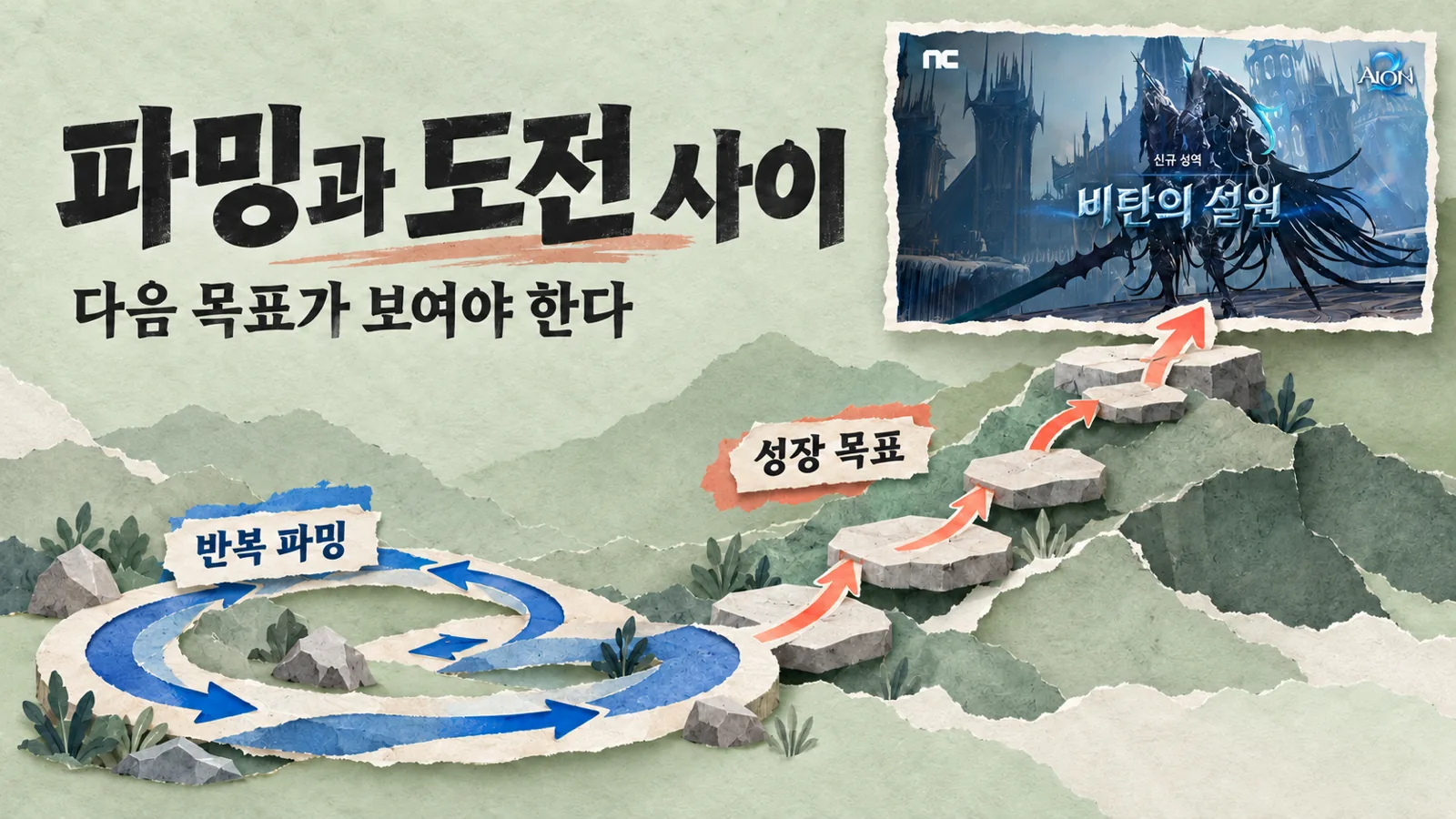
There are many things that can be agreed upon when it comes to the need for dungeons suited to the progression stage. If you can see the trend of equipping yourself with gear in easy sections and then challenging more difficult sections to get the next rewards, the purpose of upgrading your specs becomes clear. The materials you collect today are connected to the next battle.
However, you must be careful about raising the threshold of a dungeon that you can already enter. Existing users may perceive it as if the content they were using has been taken away, rather than as if a new challenge has been created. Forcing new and returning users to repeat all past dungeons in order can easily become a wall of waiting time rather than a ladder of progression if the party does not gather enough.
Combat power and entry conditions must be viewed separately. The combat power standard used in party recruitment may be a condition set by the user, and is not the same as the item level required by the game. It is difficult to judge whether a character can be used reliably just by being able to apply to a certain recruitment room. Job, role, pattern proficiency, and party composition also affect the results.
I think a more convincing improvement would be to give different goals for each progression section. While basic farming is kept easy to access, higher-level challenges require different patterns or strategy choices and provide rewards commensurate with the effort. If you increase the attack time by only increasing health and attack power, you can only increase the burden of repetition rather than creating a new goal.
You can also think about reusing existing dungeons. Give some dungeons optional weekly bonuses, or provide multiple paths to reach the same progression goal. This is not a confirmed update, but rather a suggestion for improvement. However, it is important to note that if you have to go through all the dungeons to complete the rewards, the homework list may become longer instead of increasing the options.
More content does not resolve every PvE concern
‘Abyss Outland’ was added on October 28th. This is a personal PvP content where about 100 people compete until the last person standing. For users who want new competition, this is a change that can be a different goal than before.
However, the experience desired by those who enjoy competing against other players and those who prefer defeating bosses is not the same. The mere fact that PvP content has increased does not mean that the boredom of repetitive Expeditions has been resolved. On the other hand, it is difficult to expand the disappointment of PvE into claiming that there is no change in the game as a whole.
A similar distinction is necessary when looking at living content such as housing or decoration. The fun of feeling attached to characters and spaces and interacting with other users is valuable in itself. However, it is difficult to replace the use of progression for users who adjust their gear for battle. As they provide different pleasures, the problems they solve are also different.
Therefore, when evaluating updates, the important thing to look for is connection rather than quantity. In addition to the news that new features have been added, I want to see if any inconveniences or gaps in my play are reduced. Internal development manpower and schedule allocation cannot be known based on public information alone, so there is no need to assume that dungeon development has been delayed due to specific content. It is more accurate to view it based on the actual changed playing experience.
Questions to ask before your next upgrade
If you are thinking about the next progression in AION 2, it is best to first decide specifically what changes you want to achieve. The investment required will vary depending on whether you want to tackle the next level of difficulty in Sanctuary, stabilize your party's survival and role performance, or reduce repetitive farming time. Even with the same gear improvement, satisfaction may vary depending on the goal.
If the goal is to reduce time, it is more realistic to look at the entire time, including party waiting and failure, rather than a single best record. If your goal is to challenge yourself, you need to identify what is blocking your strategy before increasing the number. If you treat lack of gear and lack of pattern understanding as the same problem, the change may be small compared to the investment.
If you are already enjoying the content you want without difficulty but do not have a next goal, you can choose to slow down the progression speed for a while. Rather than following the numbers set by others, it is never too late to check what new experience you can gain and then move on.
The expected change in AION 2's progression structure is not to increase the number of things to do every day. I hope that the goal of wanting to try things out with a stronger character will continue, while leaving the choice to comfortably run through familiar dungeons. Remembering what you can do when you get the next gear. I think that's the most important criterion for maintaining the fun of spec-up for a long time.
