

PUBG's Flamethrower is a special weapon used in SLB: Dawnbreakers of Rondo, the cooperative PvE mode in Arcade. If you expect a new gun to loot in Normal or Ranked matches, you will be looking in the wrong place. It comes from a Flamethrower Crate, with four weapons in each crate. However, Hungers in fire-resistant suits are immune to its fire damage, so it is not an answer to every enemy.
What matters most is not the spectacle of the flames, but which enemies you will handle and when you will switch to another option. SLB has a different objective from battle royale, where you eliminate other players and try to be the last survivor. Your team needs to defend an objective and escape, so filling a gap in the team's defense matters more than simply carrying a powerful weapon.
Which mode lets you use the PUBG Flamethrower?
The mode's full name is SLB: Dawnbreakers of Rondo. It is the fourth entry in the Survivors Left Behind series, a cooperative PvE experience for up to four players fighting Hungers on Rondo at night. This is the content often referred to as PUBG's zombie mode. Enter through Play → Arcade → SLB: Dawnbreakers of Rondo.
You can start with as few as one player and build a team by inviting friends or using automatic matchmaking. You do not need to assemble a full group of friends beforehand. The mode uses first-person perspective and offers Rookie and Veteran difficulties. Enemy types, numbers, and stats differ, so starting where you have room to learn the objectives and resource management is more useful than immediately choosing the harder setting.
Check the availability window as well. In 2026, PC service runs from the end of maintenance on October 14 until November 4 at 00:00 UTC, while console service runs from the end of maintenance on October 22 until November 12 at 01:00 UTC. Those closing times are 09:00 and 10:00 respectively in Korea. Check your platform's end time instead of putting it off as though it were a permanent mode.
This distinction is about more than finding the right menu. If you wondered whether the Flamethrower changes close-range weapon choices in Normal matches, first understand that it belongs to a separate cooperative ruleset. Taking its PvE role directly into a comparison of regular battle royale guns would lead to the wrong conclusion.
How to get the Flamethrower, and what makes it disappear
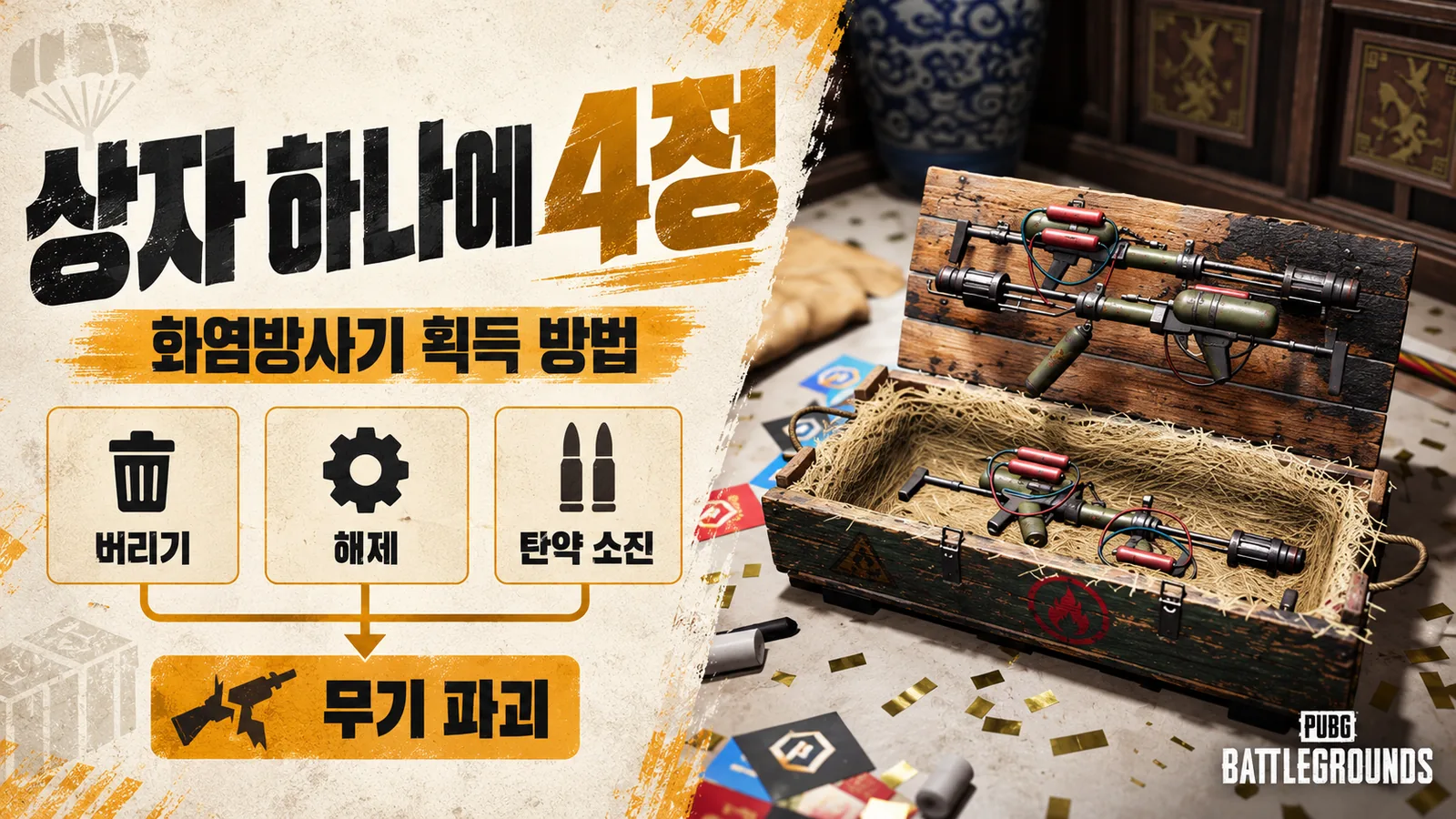
You obtain it from a Flamethrower Crate. In SLB, materials collected during combat are turned into weapons, consumables, and deployables at Crafting Desks so you can prepare for the next fight. The Flamethrower appears under Weapon Crates in the deployables section of the guide. This is different from hunting for an airdrop crate on a regular map.
Special weapons taken from crates have their own consumption rules: they are destroyed if you discard them, unequip them, or expend all their ammunition. Do not assume you can put one down briefly and pick it up again later. It makes sense to decide which enemies and defensive section you will use it for before taking it out.
Read the official guide's reference to unlimited ammo carefully in this context. Separate from the general introduction to craftable weapons, the rules for special weapons obtained from crates explicitly say they are destroyed when fully expended. You should not extend the broader statement to mean that a Flamethrower can be used permanently without managing its fuel.
Four weapons per crate encourages thinking as a team. Instead of one person monopolizing the eye-catching weapon, assign directions to cover and let the players who need it use it. That does not mean all four players should carry the same weapon. Keeping another attack option available is safer when some enemies cannot be handled with fire.
The official announcement does not specify the exact crafting ingredients and quantities, damage per second, or range. Rather than declaring a best-in-slot option based on unconfirmed numbers, prepare around the confirmed acquisition and consumption rules, and check the actual requirements shown at the Crafting Desk.
Why fire does not work on Hungers in fire-resistant suits
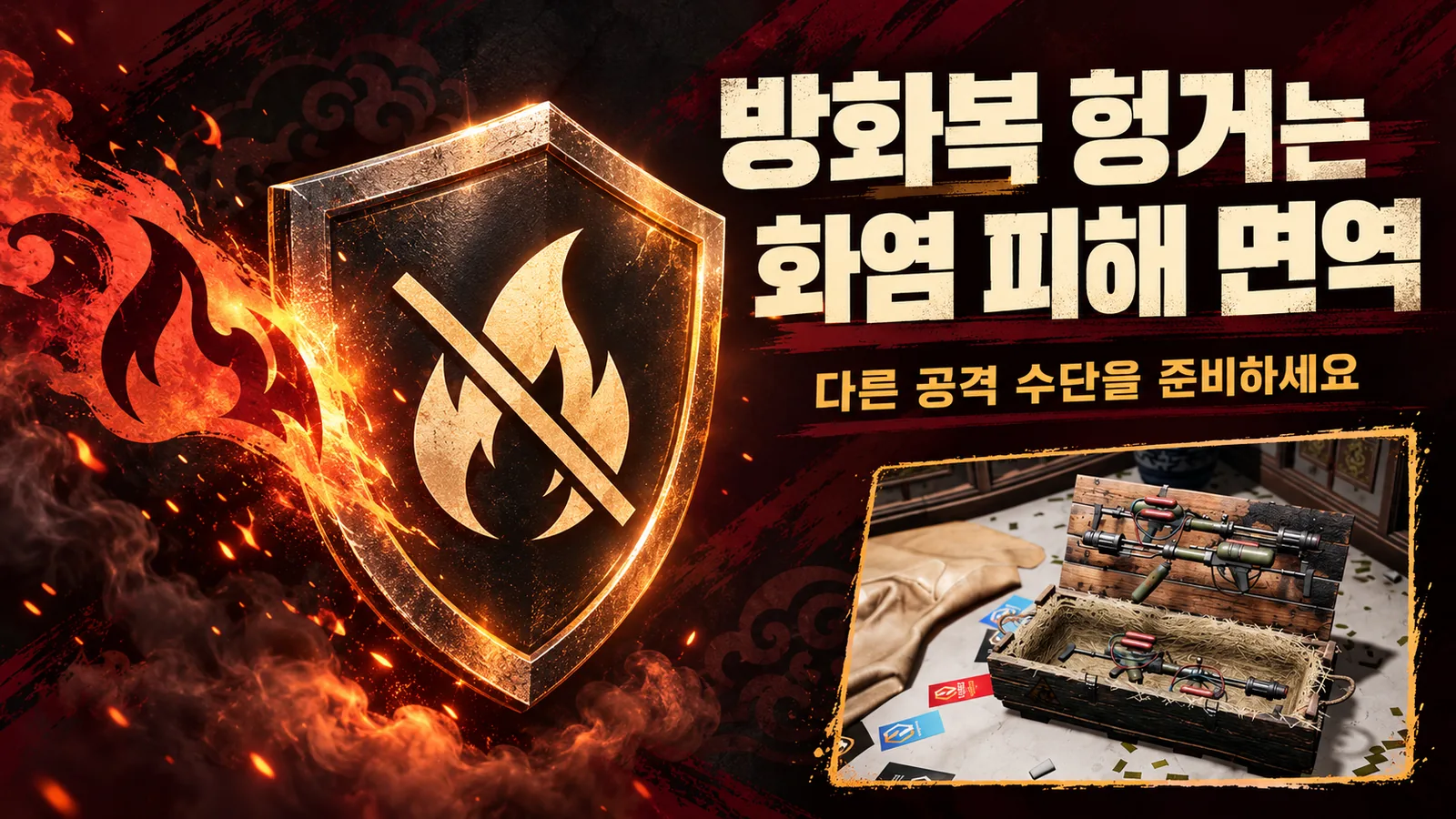
The Flamethrower deals sustained fire damage. But Hungers wearing fire-resistant suits are immune to that fire damage. This is not merely a small reduction in damage: some targets cannot be dealt with using this attack.
That condition changes how the weapon should be evaluated. Being effective against one enemy does not mean the same approach can solve every wave. If an immune enemy approaches the objective while you keep attacking it with fire, the screen may look busy even though you are failing to stop that threat. Choose your weapon for the target you need to handle, not just for how satisfying it feels.
The same principle applies to team roles. Splitting responsibility between players handling fire damage and players maintaining another shooting option makes immune enemies easier to respond to. This is not a fixed optimal composition; it is a division of responsibilities inferred from the confirmed immunity rule. You do not need exact Flamethrower stats to see why another damage option matters.
Watch the new Hungers' attack patterns too. The Shield Alpha Hunger blocks frontal attacks with its shield, so aim for its head or attack from behind. The Shooter Hunger keeps its distance and attacks with a firearm, while the Dog Hunger rushes in quickly and low to the ground. Those different threats mean you must keep checking enemy types and approach directions even after acquiring a weapon that sprays fire.
The official description does not establish that flames pass through shields or kill a particular enemy within a set number of seconds. What matters is identifying the target and keeping room to change how you attack. A new weapon being fun and being able to entrust every problem to it are separate judgments.
Defending the Capacitor matters more than piling up kills
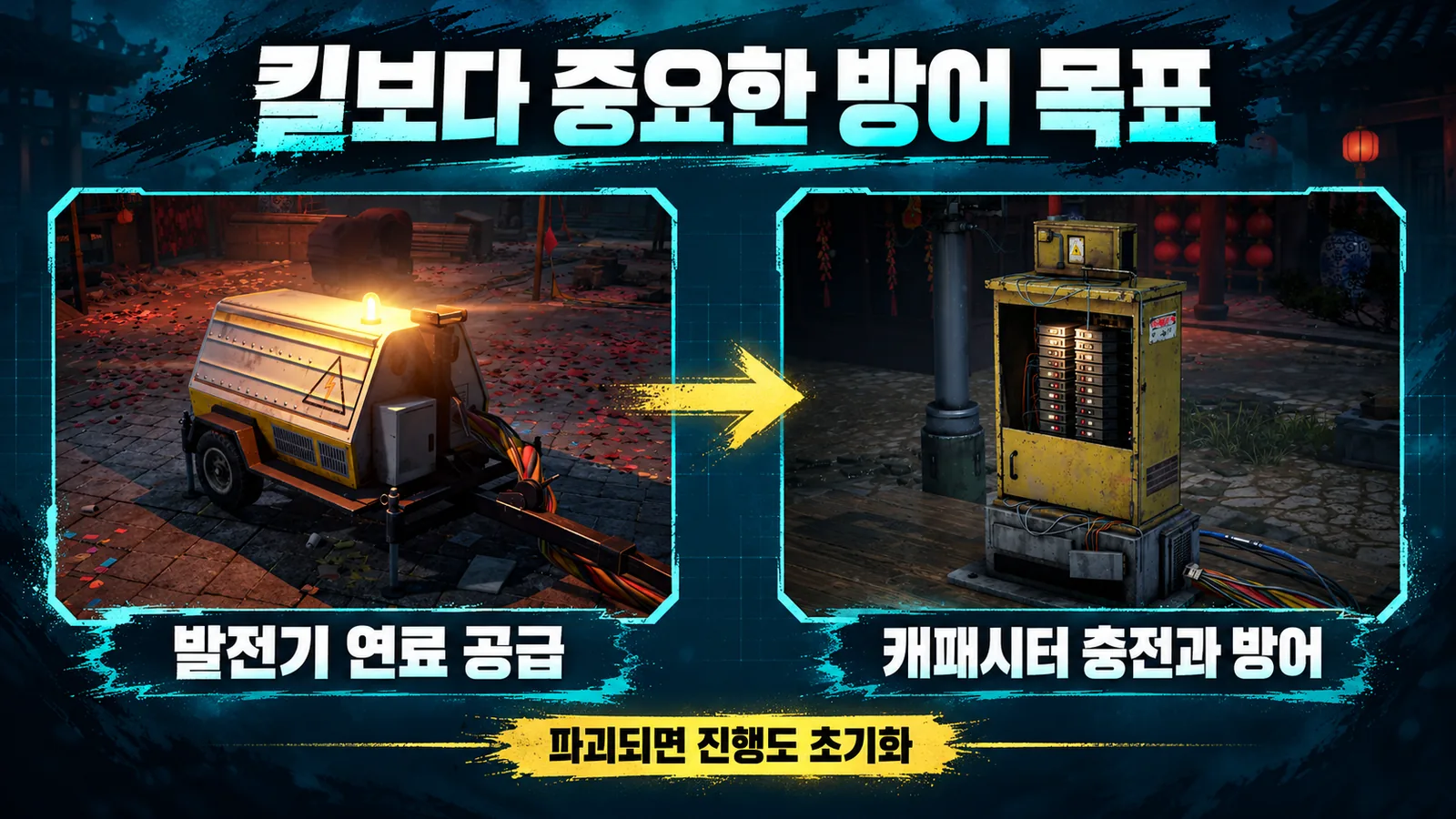
SLB's basic loop is to fuel the Generator, then hold off the Hungers while the powered Capacitor charges. A full charge allows the escape signal to be sent. If an activated Capacitor is destroyed, its progress resets. That is why stopping enemies approaching the objective can take priority over chasing enemies far away.
Evaluate the Flamethrower within that objective. Beyond whether you can attack the enemy in front of you, consider whether another entrance is being left open while you do so. If you focus on one side and miss an immune enemy on the opposite side, your personal combat results and the team's progress can diverge. Think about both killing speed and the position needed to protect the objective.
Deployables help cover those gaps. Barbed Wire slows enemies crossing it, and Light and Heavy Turrets attack automatically. A Manned Turret provides stationary firepower operated by a player, at the cost of mobility. A Healing Station restores allies' health, removes debuffs, and revives downed teammates within its area.
That does not mean placing more devices automatically solves everything. Crafting resources and placement options are limited, so first identify enemy routes and directions your team tends to leave exposed. Whether another Flamethrower or a recovery tool is more urgent depends on why your team is currently losing ground.
When forming a team for the first time, simple agreements are more useful than complicated instructions: who watches each path, who handles enemies that resist fire, and whether to place healing near the objective. Knowing everyone's responsibility reduces the decisions needed in an emergency more than memorizing weapon names does.
What should a new player learn first?
Before focusing only on special weapons, connect three basics: securing a starting weapon, using the Crafting Desk, and identifying the defense objective. You can interact with a Vending Machine at each stage's starting area to obtain a basic weapon. You need a way to keep fighting before finding a Flamethrower, as well as a response for when that special weapon disappears.
Food buffs are part of preparation too. Up to three different soups can be active together, but their effects have limited durations. Choose based on what the team needs, such as reload support, survivability, or movement. Handle crafting and recovery between fights so you do not discover a preparation gap only after the defense begins.
If you are aiming for the rankings, make the objective even clearer: only Hunger kills from successfully cleared matches on Veteran difficulty count. Increasing your kill total without completing the run does not satisfy that condition. This is another reason to prioritize the team's chance of finishing over individual firepower.
The appeal of PUBG's Flamethrower is the chance to choose a different attack style from conventional guns within cooperative play. But the questions for judging that choice stay the same: does it work on the current target, will another response remain available afterward, and does it help defend the objective? When you can answer all three, the Flamethrower becomes more than a spectacle—it becomes a weapon your team actually needs.
Reference: Official SLB: Dawnbreakers of Rondo announcement. Service times above are in UTC.