

KMS equipment guide · About these guides
After obtaining a Plasma Heart, the next decision is Star Force. Its 20-star cap offers useful potential, but Safeguard and recovery costs belong in the budget from the start.
As the bill rises, it is easy to start thinking:
“Maybe this attempt will succeed.”
“Maybe my luck will be different.”
Confidence does not change the displayed probabilities. Plasma Hearts are not freely tradable spares, so choose a target and a spending limit before starting.
Plasma Heart basics
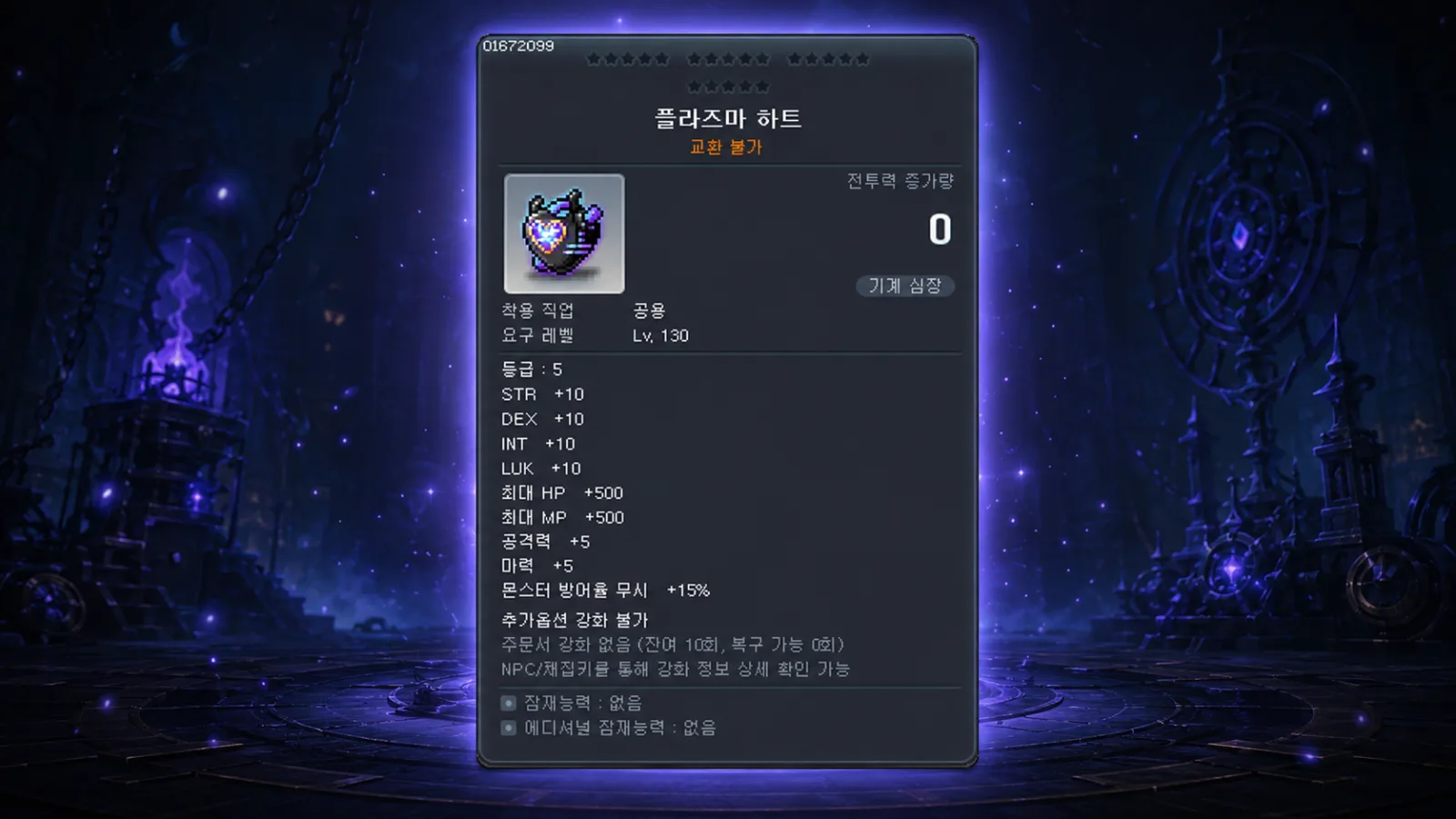
In KMS, Plasma Heart is a level-130 mechanical heart with a special maximum of 20 stars.
Its base properties include:
- STR, DEX, INT, and LUK +10
- Attack and Magic Attack +5
- Max HP and MP +500
- Ignore Enemy Defense +15%
- 10 available scroll upgrades
Heart Upgrade Module: Plasma can upgrade eligible permanent Fairy, Titanium, or Lidium Hearts. Hearts with restricted enhancement or binding states may be ineligible; check the module's conditions before purchasing anything.
The upgrade carries over these properties:
- Remaining scroll slots and recoverable slots
- Star Force level
- Stats gained or lost through enhancement
- Potential
- Bonus Potential
Keeping the old heart's work is useful, but further Star Force attempts on the Plasma Heart still have their own destruction risk.
Why replacement access matters
For a tradable item, you may be able to buy another copy for recovery. A Plasma Heart is untradable, so you cannot assume a replacement will be available when needed.
Some Korean event meso shops have sold replacement Plasma Hearts only to characters holding the heart or its trace. That historical shop rule does not guarantee a currently open shop; check its dates, stock, and eligibility.
Count more than the meso amount shown for one attempt.
- Mesos for Star Force attempts
- The additional Safeguard charge where it is available
- An eligible replacement heart or other permitted recovery route
- Any further enhancement needed after recovery
- The risk of losing access to an event-limited spare
Turning Safeguard off lowers an attempt's immediate price, but a destruction can outweigh those savings or leave the item unusable until recovery becomes available.
Should you turn Safeguard off?
Safeguard adds mesos to eligible attempts. A series of unsuccessful attempts can make that extra charge frustrating. Do not assume an old failure or star-drop rule still applies to your version.
Disabling it is a decision to accept destruction risk, not just a cheaper price. Verify that Safeguard is offered for the exact attempt and read the displayed chances.
Keeping it enabled is especially sensible when:
- You have no confirmed recovery route
- You cannot afford to resume progression after destruction
- The heart already carries valuable scrolling and potentials
- Losing the heart would stop your character's progression
- A 17- or 18-star heart already meets your current needs
Accepting risk can be a deliberate option if you have a usable recovery route and enough budget afterward. It still does not make success certain.
The useful question is whether your plan survives a failure, rather than whether you feel due for a success.
Who should consider 17 stars?
Seventeen stars is a practical intermediate target in the source's setup.
Compared with its 8-star Fairy Heart baseline, Plasma Heart adds base properties and further Star Force stats. Its 15% IED combines multiplicatively with other IED sources; it is not simply 15 percentage points of final displayed IED.
Consider stopping here if:
- This is your first Plasma Heart
- You are developing a character with limited seasonal mesos
- Other equipment is still below its useful intermediate targets
- Your main or Bonus Potential needs work first
- You want a usable heart without committing to the final stars
With a limited budget, stopping at 17 and improving other slots can produce a better overall setup.
Who should consider 18 stars?
Eighteen stars can be a reasonable compromise between cost and performance.
It adds one step beyond 17 without committing to the entire 19-to-20-star push. Keeping an 18-star heart for a while is a valid plan.
After reaching 18, compare the next attempt with other upgrades:
- Useful intermediate Star Force targets on other gear
- Weapon, secondary, and emblem Potential
- Bonus Potential improvements
- HEXA Stats and HEXA core levels
- Symbols and other predictable progression
An affordable improvement elsewhere may offer more value than pushing the heart straight to 20 stars.
Who should consider 19 or 20 stars?
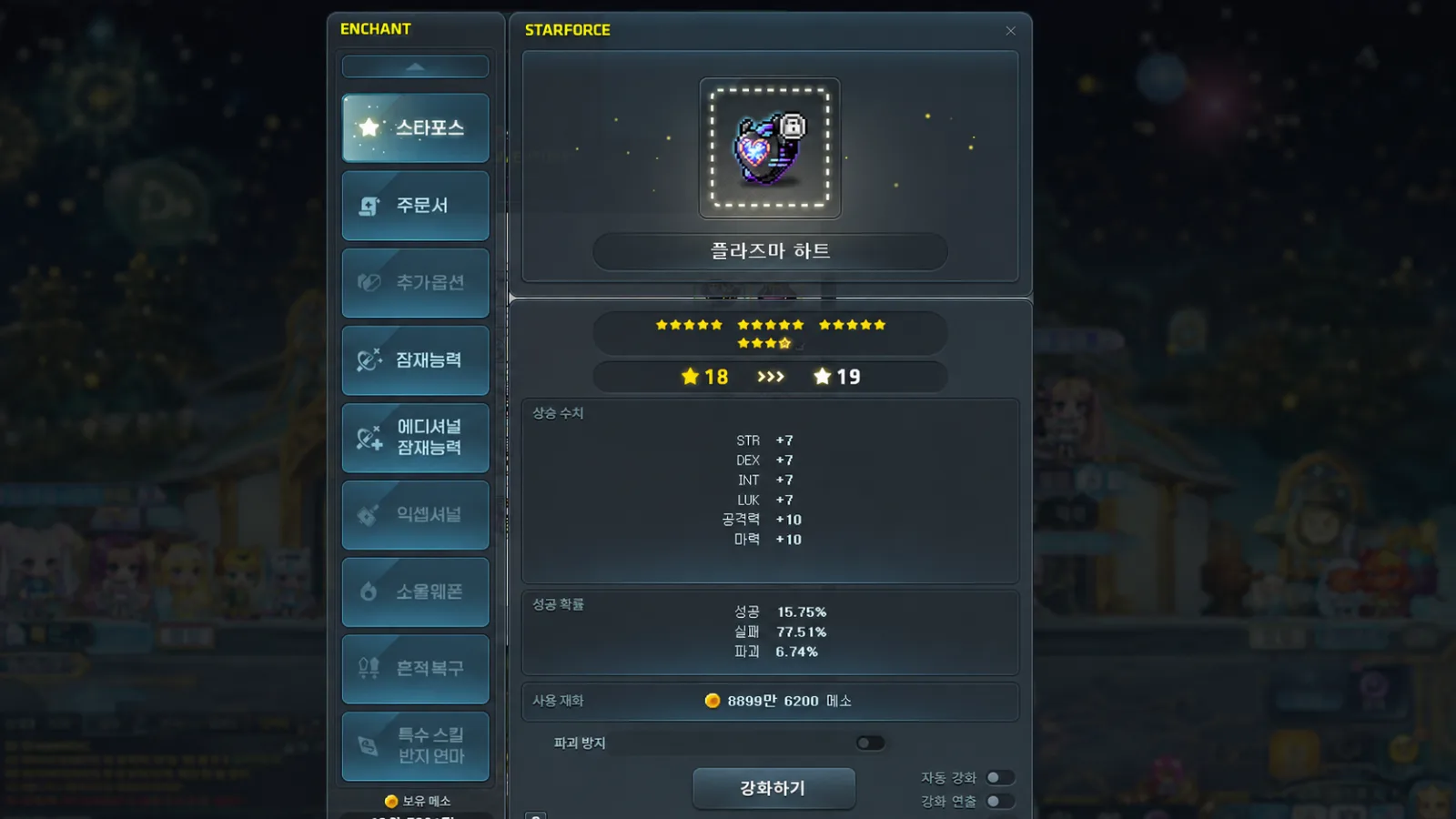
These targets are for a plan with enough mesos and confirmed recovery access.
The Korean source lists these differences against its 8-star Fairy Heart reference. They are comparison figures for that baseline, not the heart's total stats or a guaranteed gain over every existing heart:
- 17 stars: Attack/Magic Attack +20; main and secondary stats +45
- 18 stars: Attack/Magic Attack +29; main and secondary stats +52
- 19 stars: Attack/Magic Attack +39; main and secondary stats +59
- 20 stars: Attack/Magic Attack +50; main and secondary stats +69
The Plasma Heart also has its base 15% IED. Check an actual before-and-after tooltip for your heart, scrolling, and version.
Twenty stars has more stats, but attempts and recovery can cost more than expected. Reaching 19 quickly does not oblige you to spend the rest of the budget on 20.
Plan the upgrade in four steps
Use the following planning order:
1. Decide on scrolling
Compare applicable Spell Trace, special heart, and Magical Scroll options against your budget and regional availability.
Know the intended finished state before spending heavily on Star Force. Unfinished scroll work can add costs you have not yet counted.
2. Inspect the inherited potentials
Check the Potential and Bonus Potential that will transfer from your existing heart.
Destruction generally creates a trace under the applicable rules; valuable options are not necessarily erased permanently. The practical problem is having an eligible route to recover and use them again.
3. Set a Star Force target
Pick an intended stopping point such as 17, 18, or 20 before beginning.
“Keep going until it succeeds” is not a defined budget and can consume mesos needed for ordinary progression.
4. Set a spending stop
For example, stop at 18 stars or at a fixed amount spent, whichever comes first.
Reaching 19 does not require another attempt. Remaining resources and recovery access matter more than how close the next star feels.
Before you enhance

Check these points before pressing the button:
- Can you actually obtain the required replacement or use a permitted recovery method?
- Have you checked the relevant shop's sale period?
- Will enough mesos remain after a destruction?
- Have you set both a target and a maximum spend?
- Can you keep progressing at 17 or 18 stars?
- Would another equipment upgrade offer better value?
- Can you continue playing if the session goes badly?
If an essential part of the plan is unresolved, postpone the high-risk push.
A sensible stopping point
Plasma Heart combines useful base properties with its special 20-star cap. Untradability and limited spare access make recovery planning particularly important.
Safeguard is not automatically wasted spending. Compare its charge with the consequences and availability of recovery, using the current enhancement screen.
Seventeen or eighteen stars can be a complete near-term plan. Twenty stars is a further goal for an adequately funded setup, not a mandatory beginner requirement.
A useful enhancement plan leaves your character able to continue progressing even after an unlucky session.