

KMS test preview · Historical · About these guides
The Korean source evaluated Khali's test-world sixth-job skill Hex: Dune Burst before its July 2026 live release. The English name here renders the KMS name; this is a historical preview, not a current GMS skill ranking.
The source reports a skeptical community response, arguing that the preview added little to Chakri generation and Resonate interactions. Those reactions are the source's account, not a representative survey or a verified current consensus.
Its preview recommendation was to avoid rushing directly to maximum level. That conclusion cannot be carried forward unchanged: September KMS increased the listed max-level slash from 237% to 576% and sand explosion from 426% to 863%, alongside other Khali changes.
Unlocking a skill and investing enough fragments for high levels are different decisions. The useful current question is which next upgrade provides the most total output for its cost.
Reported figures such as 0.8% damage share or 0.3% total improvement were not official universal results. The source did not provide a reproducible dataset establishing those numbers.
Gear, skill level, existing cores, fight duration, burst count, and boss behavior can all change the comparison.
What the preview criticism concerned
Interaction with Khali's existing kit
Khali's play involves more than pressing every ready attack in order.
Arts and Hex attacks interact with Void Rush and Void Blitz cancels and the conditions that generate Chakri.
Chakri contribute through Resonate attacks; Death Blossom and Resonate: Ultimatum are important parts of the coordinated burst kit.
The source therefore wanted more than a large damage percentage from a new skill. Possible improvements it valued included:
- Help generating Chakri
- More useful Resonate activations
- Smoother Void cancels
- A stronger Death Blossom interaction
- A shorter practical burst window
- More reliable hits against moving bosses
An improvement in one of these areas could address a practical limitation as well as add damage.
The preview article viewed Dune Burst mainly as a separate attack rather than a major kit redesign. That is its historical evaluation; subsequent live changes need a fresh comparison.
The reported low damage share
The source mentions test results with less damage share than some players expected, without supplying a complete reproducible protocol.
A useful share comparison needs the surrounding conditions:
- Equipment and stats
- Dune Burst level
- Existing HEXA levels
- Fight duration
- Burst count
- Target size and movement
- Void-cancel execution
- Resonate hits
Different conditions can substantially change one skill's share even before a patch changes the skill itself.
A reported 0.8% share in one setup cannot establish the result for every Khali or for the later buffed KMS version.
Compare the complete rotation before and after an upgrade with otherwise matched conditions.

Fragment cost versus useful gain
Sixth-job development consumes Sol Erda and fragments, so an upgrade has an opportunity cost.
If essential existing cores are still low, their next levels may beat a high-level investment in the new skill. Measure rather than assume that outcome.
A small direct damage share can still come with valuable passive or linked benefits, if the actual skill has them.
Conversely, a low total improvement after accounting for all effects may place the next level behind another upgrade.
Remember that Battle Analysis share and total character damage improvement are different measures, even when both are expressed as percentages.
A skill dealing 1% of the final rotation's damage does not automatically mean unlocking it increased the old rotation's total by exactly 1%.
Check whether casting it displaced other attacks, lengthened setup, or shifted the next burst.
What to compare before upgrading
Total output before and after
Start with the full rotation's damage, rather than the new attack's share alone.
If the added cast reduces uses of established attacks or delays the burst, count that loss.
If it fits without displacement, a modest extra contribution can still be worthwhile.
Gain per fragment
Compare alternative upgrades at the same resource budget, also accounting for any Sol Erda constraint.
For example, a hypothetical 0.5% total gain loses to a 1% gain at the same cost. These are arithmetic examples, not measured Dune Burst results.
A new core may become more attractive once existing cores reach expensive, lower-efficiency levels.
Real-boss hit reliability
A stationary practice target does not reproduce a moving or temporarily invulnerable boss.
Check missed attacks, cast positioning, and any effect on survival or the next burst.
A skill that disrupts a familiar Void-cancel flow may deliver less than its stationary-target result until the player adapts.
Interaction with the rest of the kit
The source suggested that these kinds of changes could alter its assessment:
- Additional Chakri generation
- Resonate improvements
- Death Blossom interactions
- Easier Void cancels
- More compact burst
- Synergy among Hex skills
This list describes desired improvements, not a claim that Dune Burst currently supplies all of them. September's actual coefficient increases must also be included in a new evaluation.
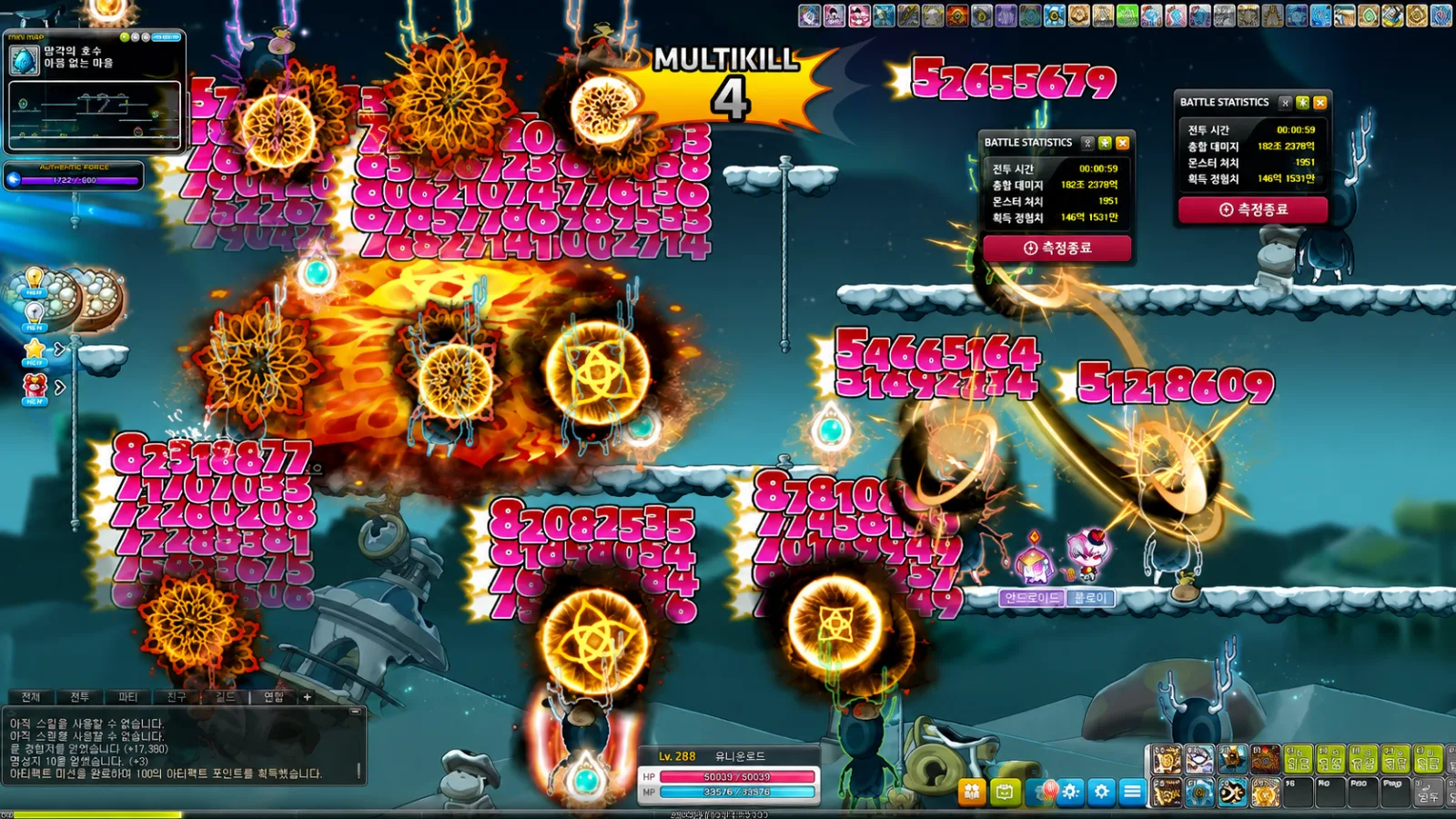
A practical comparison method
Match conditions before comparing the rotation with and without the skill, or before and after a specific level upgrade.
1. Keep the setup consistent
Match the following:
- Equipment and potentials
- Inner Ability
- Legion and links
- HEXA Stats
- Other HEXA core levels
- Buffs and consumables
- Fight duration
- Burst count
- Target and its settings
A comparison that changes several of these at once cannot isolate the upgrade's contribution.
2. Record the baseline
Repeat the baseline rotation at least three times as an initial check, using the skill-disabled or pre-upgrade setup where the game permits it.
Use repeated runs to estimate variation. Three runs are a starting point, not proof of statistical certainty.
- Total damage
- Duration
- Burst count
- Death Blossom contribution
- Resonate contribution
- Hex contribution
3. Repeat with the upgrade
Enable the new skill or apply the candidate upgrade, then repeat under the same conditions.
Check whether important established attacks were delayed or missed.
Include any displaced damage in the comparison instead of counting only the new attack.
4. Calculate the total change
For matched-duration runs, calculate:
Improvement (%) = (after total damage − baseline total damage) ÷ baseline total damage × 100
The full-rotation change is more useful for this decision than one skill's share in isolation. If durations differ, compare rates and explain the difference.
5. Compare the alternatives
Estimate the result of spending an equal budget on existing mastery or boost cores.
If another upgrade offers more useful gain at that budget, it can take priority. Recheck after meaningful balance changes rather than preserving the preview's ranking indefinitely.
The preview's two investment paths
| Comparison | Prioritize Dune Burst levels | Prioritize established cores |
|---|---|---|
| Possible fit | A character whose existing core development is already advanced | A character with useful existing cores still at low levels |
| Potential benefit | Develop an additional attack | Improve frequently used established attacks |
| Trade-off | Its next-level value still needs comparison | The new skill develops more slowly |
| Practical reliability | Check targeting and how the cast fits | A familiar rotation is easier to compare, but still needs current data |
| Kit interaction | The source found little structural change in the preview | Develop existing Chakri and Resonate interactions |
| Fragment value | Requires current-version measurement | Can be easier to estimate from a well-recorded baseline |
| When to compare | After checking the live skill and later patches | When existing cores offer useful next levels |
| Historical recommendation | The preview advised holding off on a large commitment | It advised most developing characters to compare established cores first |
Why a large existing investment changes the question
The source focuses on heavily equipped Khali examples. It does not establish that most Khali players have such a setup.
Its high-investment examples include:
- A heavily enhanced Destiny chakram
- A Destiny chakram with unusually high-tier main Potential lines
- A weapon with three useful Attack Bonus Potential lines
- An Astra Hex Seeker
- Heavily enhanced Brilliant Boss equipment
- Immortal Legacy with applicable Exceptional Enhancement
- High HEXA Stats
- Well-developed main HEXA cores
For such a character, the next upgrade can be expensive, making the gain per resource especially relevant. These are source examples, not beginner requirements or confirmed GMS availability.
A small improvement may feel disappointing after a large prior investment, but that feeling does not replace a matched comparison.
Equipment prices also depend on world, date, potentials, bonus stats, and enhancement state.
Do not generalize one player's spending to everyone who plays the class.

How to use the preview responsibly
Do not rank the skill from an unexplained damage share
Community Battle Analysis screenshots often come from different setups.
At minimum, ask for:
- Character stats
- Skill level
- Measurement duration
- Target
- Burst count
- Other HEXA levels
- Repeated-run count
Without this context, a share figure is a weak basis for another character's investment decision.
Separate share from improvement
A new skill's share and the gain caused by an upgrade are not interchangeable.
A 1% share does not prove an exact 1% total improvement.
Count changes to the rest of the rotation as well.
Do not use Sol Janus boss share as the comparison
Sol Janus primarily serves training coverage and convenience, despite being part of sixth-job progression.
Comparing its bossing share directly with a boss attack such as Dune Burst does not answer the upgrade question.
Use an equal-cost character upgrade and a matched combat goal; cross-class comparisons need even more controls.
The preview is no longer the live balance state
This article's original judgment concerned the test world.
Hits, coefficients, cooldowns, passives, and linked effects could change before release and did receive later balance changes.
September KMS substantially increased Dune Burst's listed slash and explosion damage. Its old preview percentages should not be repeated as current measured performance.
The useful question is broader than whether the new skill is “good” or “bad.”
Check how it fits Death Blossom, Chakri, and Resonate and how much useful total output its next level adds compared with other affordable upgrades.
A later interaction or balance change can move the priority again, so date any test result.
Even without a major redesign, coefficient changes can materially alter value. Re-evaluate the live skill instead of assuming the preview's cautious recommendation must still apply.