

KMS gearing example · About these guides
Temporary Challenger gear from Item Burning is a useful starting setup, but eventually needs permanent replacements. A common decision is whether to move into Eternal or Arcane Umbra armor.
The Korean source describes Eternal becoming more accessible and players planning around a full set earlier. You do not have to replace every piece at once: mixed setups can bridge the transition when their actual set effects work for the character.
This guide compares those Korean progression routes. The set names below sometimes describe effective set-bonus counts rather than literal numbers of armor pieces, so verify the equipped items and Lucky Item conditions before buying.
Why the Korean source discusses more Eternal builds
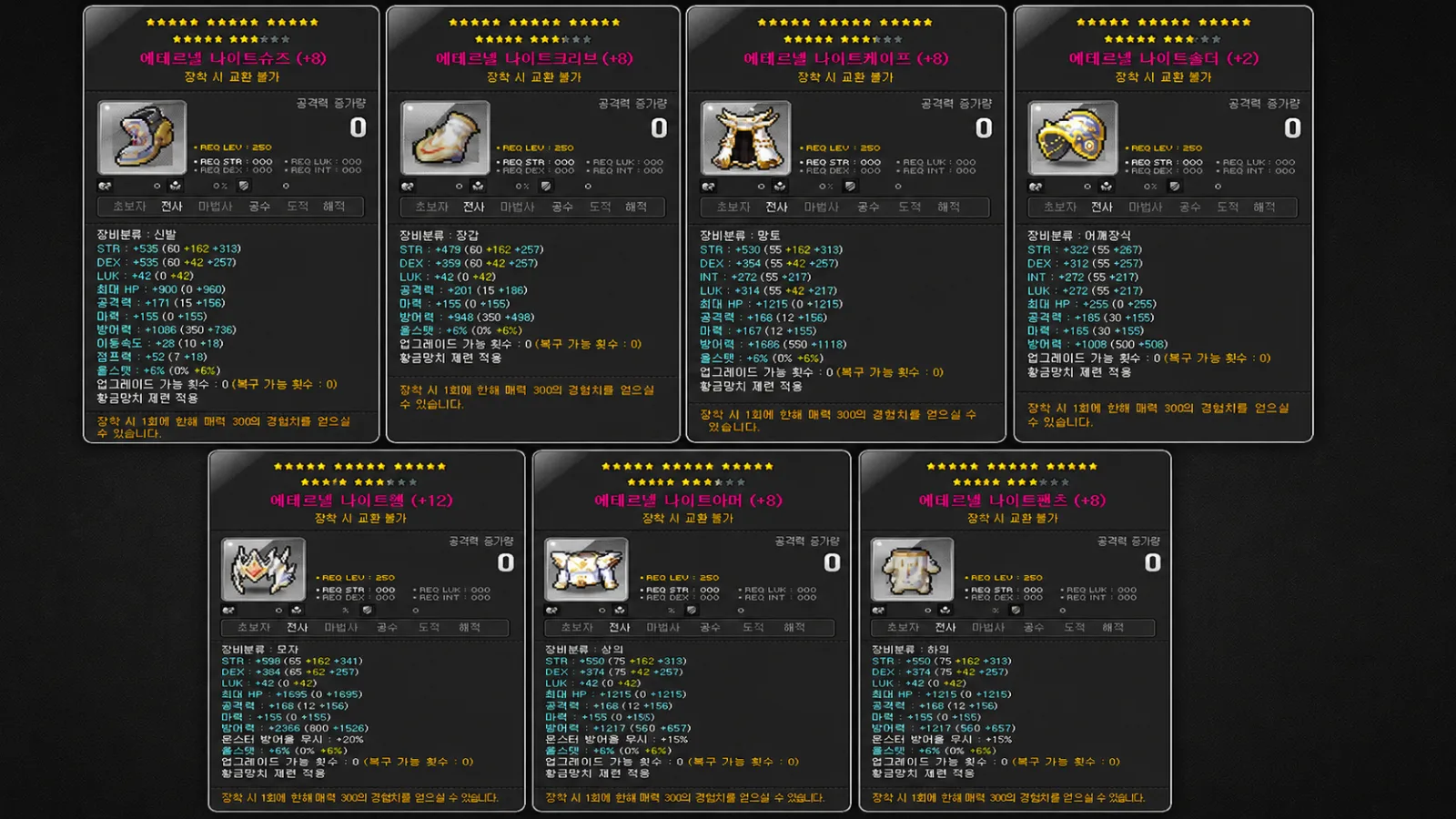
Eternal is level-250 armor used as the long-term endpoint in this reference. The source attributes broader access to increased supply and different enhancement options; it does not establish current prices or availability in every region.
More supply can create more item choices
In a trade-enabled market, equipment can circulate beyond its first owner, subject to the item's trade limits. Over time, that can create a range of unfinished and finished candidates.
The source considers several stages:
- 17-star Unique Eternal
- 18-star Legendary Eternal with two useful lines
- More developed 18-star-plus Legendary pieces
- Pieces intended to reach 22 stars later
Star Force, main Potential, Bonus Potential, and remaining work can make two Eternal items very different purchases.
Korean Memento cubes and self-rerolling
KMS boss rewards include Memento cube products for eligible equipment. Check the level limit: a cube marked for level-200-and-below equipment cannot reroll level-250 Eternal armor. Do not count those ordinary boss cubes as unrestricted Eternal rerolls.
Memento enhancement also applies a 30-day trading lock from the last use, regardless of the original trade state. That lock does not erase the item’s ordinary restrictions afterward, and cannot simply be bypassed with Scissors of Karma during the lock. Compare self-rerolling only with an eligible product and a realistic trade plan.
A self-rerolled item can take more resources than expected. Compare the finished candidate with the full work still required, not merely the base price.
Growth pace changes the value of bridge gear
The source argues that faster character progression can shorten how long some players use intermediate gear.
That makes the planned lifespan relevant alongside the immediate price. A cheap bridge can still cost more overall if it must be replaced soon.
Choose the goal before leaving the temporary set

The target boss and how long you expect to play the character determine which route makes sense.
Check:
- The content and boss target
- Main or limited-purpose alt
- Available mesos
- Destination-world Legion and Links
- Current IED and Boss Damage
- Whether the plan eventually includes 22-star armor
- Self-enhancing versus obtaining a finished item
An alt stopping at a defined goal may benefit from inexpensive finished bridge gear. A long-term main may prefer pieces it can keep improving, provided that route fits the total cost.
The source's early 7-Challenger/2-Eternal reference
The idea is to retain useful Challenger bonuses while replacing a weaker temporary slot. Do not interpret the label as nine distinct armor pieces or assume the effective set count activates on every setup.
The example focuses on Eternal gloves instead of Challenger gloves to gain useful Critical Damage Potential. Compare the complete set before and after the swap; losing a Challenger bonus can offset an individual item's improvement.
Glove candidates differ by:
- 17 or 18 stars
- One or two Critical Damage lines
- Useful main-stat lines alongside them
- Bonus Potential where available
- Bonus-stat quality
A finished double-Critical-Damage roll is not required immediately. Compare a usable pair within budget with the eventual replacement or enhancement plan.
The source's 5-Challenger/4-Arcane reference
Another bridge combines temporary equipment and Arcane Umbra armor.
The source uses Genesis weapon Lucky Item interactions in its mixed-set examples. Those interactions have specific set-count conditions: verify them in the equipment window rather than assuming Genesis adds a bonus to any one or two pieces. Place shoulder, gloves, shoes, and cape according to the complete arrangement that actually activates.
Arcane candidates might include:
- 18-star Legendary with two useful lines
- 18-star Legendary with three useful lines
- Finished items with suitable Bonus Potential where available
- Eligible base pieces for an enhancement coupon
Arcane pieces can remain usable after the temporary gear expires. If full Eternal is the intended endpoint, however, include the cost of replacing those Arcane pieces later.
A mid-stage Eternal/Arcane mix

A permanent mixed set is another route after leaving Challenger equipment.
One example starts with Eternal hat, top, and bottom plus another Eternal slot, filling the other armor slots with Arcane. If Eternal gloves are already owned, compare Arcane shoulder, cape, and shoes as the complementary pieces.
If Arcane gloves, shoes, and cape are already usable, Eternal hat, top, bottom, and shoulder provide a different candidate arrangement. Calculate actual bonuses with the weapon and Lucky Item rules included.
Choosing the shoulder
The shoulder can change which complete set bonus is active.
- An Arcane shoulder can support a setup emphasizing its Boss Damage bonus.
- An Eternal shoulder can support a setup emphasizing an IED bonus.
A character with undeveloped destination-world account bonuses may value IED differently from one already well covered. If IED is sufficient, the Boss Damage alternative may compare better.
Use the actual complete set and the character's stats instead of choosing a shoulder by name alone.
Moving toward full Eternal armor
Replacing the remaining Arcane gloves, shoes, cape, or other slots with Eternal moves the setup toward the source's long-term endpoint.
Eternal offers a higher-level base and its set effects, with room for later Star Force growth beyond an initial 18-star stopping point. The real comparison still includes every potential and enhancement, not just the item tier.
This route can suit players who:
- Plan a long-term main
- Want to limit repeated replacements after temporary equipment
- Intend to develop toward 22-star armor
- Prefer upgrading long-term pieces over buying several bridges
If the full route is too expensive now, compare important set-count pieces and usable intermediate states before purchasing gradually.
Keeping a developed Arcane setup
You can also continue using Arcane equipment that already has useful stars and potentials. Existing ownership changes the cost comparison substantially.
Strong 22-star Arcane pieces may already meet the next boss goal.
Further growth might involve better potentials or a later Eternal transition. Include that later cost before buying an expensive Arcane setup solely as a short bridge.
Where Fafnir and AbsoLab still fit
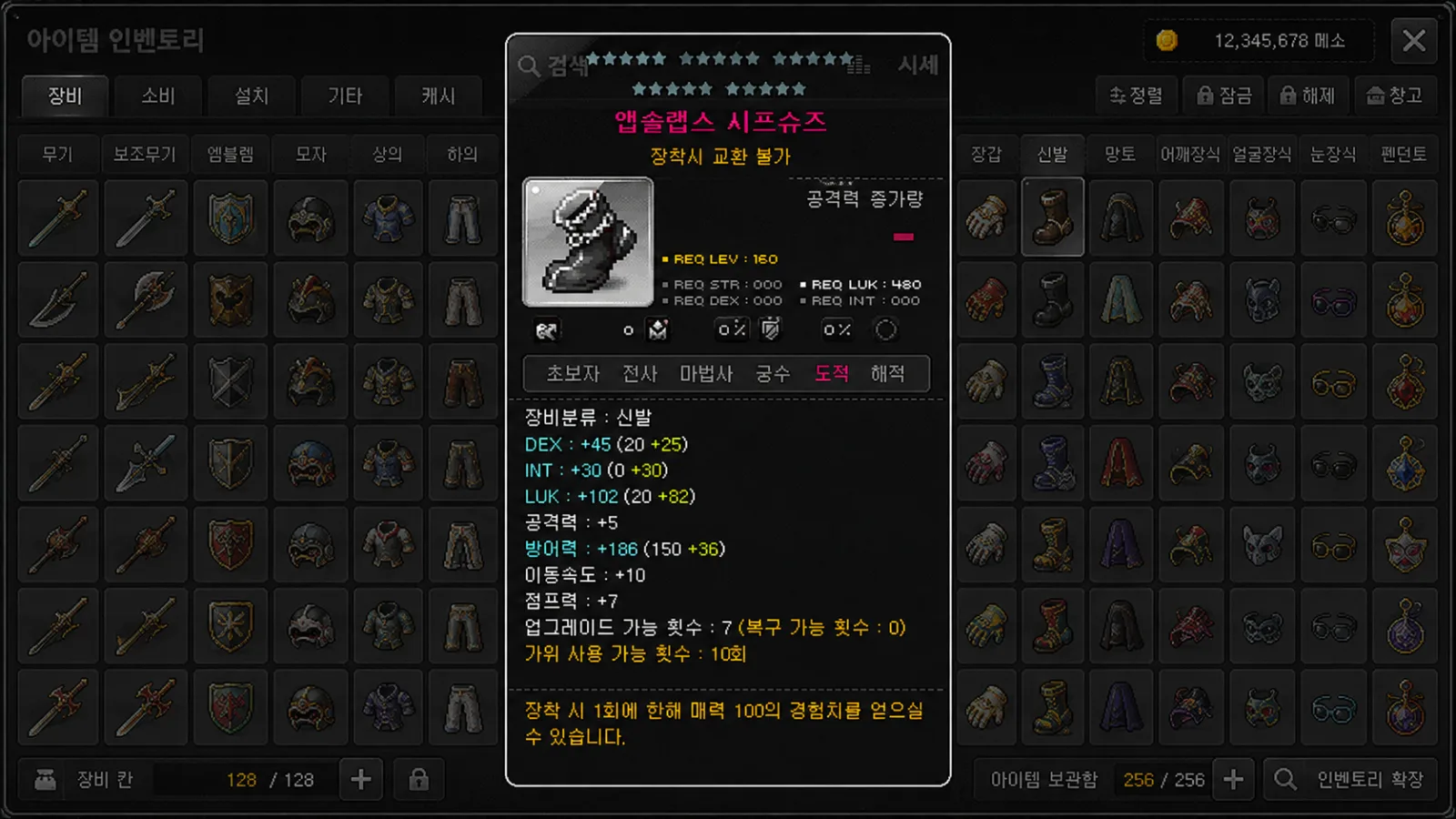
The lower tiers can still serve a specific, limited goal at the right cost.
Fafnir armor
In a Korean trade-enabled market, a finished Fafnir setup can sometimes be cheaper, including a useful cooldown hat. Check actual candidate prices rather than assuming the lower tier always wins on cost.
Compare a real 22-star Fafnir piece with a real 18-star Eternal candidate. Fafnir can suit an alt with a fixed target even if it offers less room for the intended long-term route.
AbsoLab armor
Finished AbsoLab gloves, shoes, cape, or shoulder may also be candidates. Some mixed arrangements use Eternal top/bottom with AbsoLab bonuses, but need the exact set and Lucky Item conditions checked.
A lower acquisition price can meet a limited boss goal. A long-term main may instead pay for multiple later replacements, so compare the full route.
Eternal versus Arcane: the source's comparison
| Factor | Eternal armor | Arcane Umbra armor |
|---|---|---|
| Item level | 250 | 200 |
| Starting cost | Often higher in the source's Korean comparison | Many possible enhancement states |
| Common candidate states | Around 18 stars | Around 22 stars |
| Planned growth | Room to develop toward the intended 22-star setup | Less room before replacing a piece already at the comparison's 22-star target |
| Finished-item supply | The source describes increasing Korean availability | Price varies substantially with item quality |
| Long-term main | A possible long-term foundation | Existing ownership can favor keeping it |
| Short-term value | Depends on the actual candidate | Can be useful with an inexpensive finished item |
An actual 22-star Arcane candidate may beat an actual 18-star Eternal piece immediately. An Eternal piece may offer the intended later progression route. Neither star label alone settles the comparison.
Separate current performance, cost to finish, and later replacement cost before choosing.
Before obtaining a piece
Compare the entire item state rather than only stars:
- Star Force
- Main-stat and Critical Damage Potential lines
- Bonus Potential where available
- Bonus stats
- Scroll work where available
- Gained and lost set bonuses
- Trading restrictions
- Later trade or resale eligibility
- Cost of the next enhancement
- Alternative armor at the same total cost
World-transfer periods, enhancement events, and boss supply can affect listings. The article's past market observations are not current quotes.
Possible routes by character goal
New character
Use the temporary set's remaining life to compare a useful Eternal glove or Arcane bridge. Avoid replacing several slots before calculating the bonuses you would lose.
A limited-purpose bossing alt
Finished Fafnir, AbsoLab, or Arcane can fit a defined target. Less long-term growth room matters less if you intend to stop there.
A long-term main
Plan the Eternal endpoint and the affordable intermediate setups. Starting at 17 or 18 stars and developing later is one option when the complete costs work for the character.
An existing Arcane owner
Good 22-star pieces do not need replacing immediately. Compare the real Eternal improvement with the cost of giving up what you already own.
Choose a route, not just a set name
Eternal's appeal in the source is a combination of usable current performance and the intended long-term development path.
Graduating from Item Burning does not require buying the entire set at once. Verified temporary/permanent or Eternal/Arcane mixes can bridge the transition.
Choose the boss goal, available resources, and expected lifespan first. That makes it easier to avoid buying several versions of the same slot without a useful reason.