

Korean build comparison · About these guides
The Korean source compares three Wind Fury Aeromancer Ark Grid combinations: Biyeoncham 111, Current Control 221, and a Piercing Wind-focused 333 setup nicknamed “Kalst.” These number strings identify the source’s combinations, not universal English-client preset codes. Some Korean Core names below are descriptive or romanized where an exact Western name was not verified.
The source favored 111 for learning, 221 for players comfortable managing Current Shield, and 333 for a concentrated Piercing Wind payoff. Those are build impressions from August 2026, not a verified current DPS ranking. Match the actual Core effects, points, skills, and patch in your region.
Core setup comparison
| Source combination | Main emphasis | Source’s execution assessment | Source’s defensive assessment | Potential fit |
|---|---|---|---|---|
| Biyeoncham 111 | Fast, comparatively straightforward umbrella sequences | Lower management burden | Less shield-focused | Learning the setup or playing an alt |
| Current Control 221 | Sustained attacks while preserving Current Shield | Moderate management burden | More shield-focused | Players who enjoy maintaining conditions |
| Piercing Wind-focused “Kalst” 333 | Concentrated payoff on Piercing Wind | Higher commitment and accuracy demands | Intermediate in the source’s comparison | Players specifically drawn to that skill |
Actual damage depends on gear, active effects, encounter, and execution. Compare the conditions you can maintain, rather than the highest isolated training result.
Biyeoncham 111: umbrella rotation
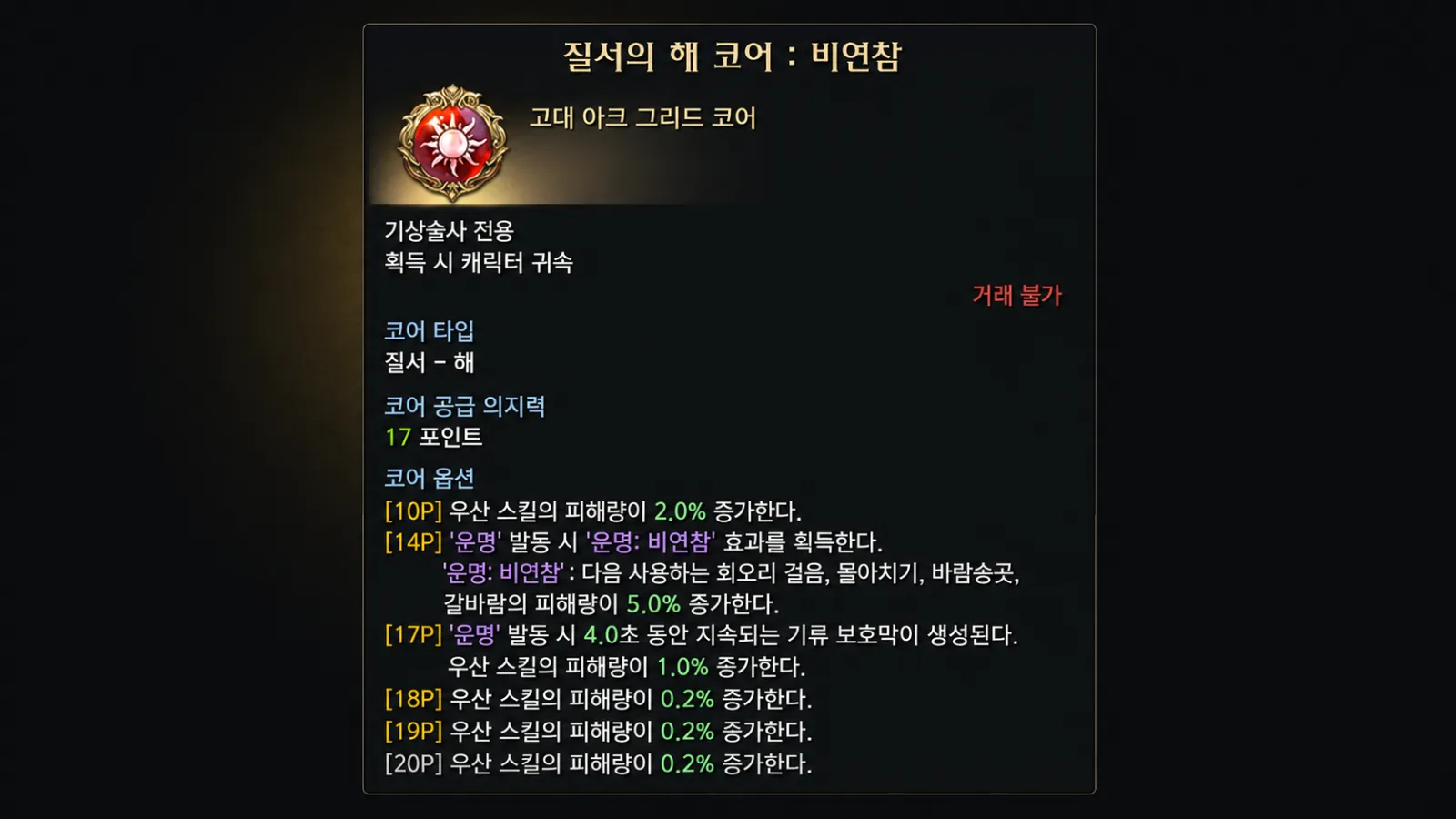
The source combines the Korean-named Biyeoncham Sun Core with an “Umbrella Dance” Moon Core and Driving Hit Star Core. The first two labels identify its Korean setup rather than claim verified current Western Core names; compare the actual effect descriptions. It emphasizes quickly connecting umbrella skills.
What the source liked about 111
It found fewer persistent shield conditions to monitor and less concentration of the payoff into one hit. That can make the basic loop easier to learn, provided the intended effects are active.
Short openings can also suit a compact sequence, though movement or transitions can still cause missed attacks.
The source particularly liked the feel of Tornado Dance and Rage in the setup.
Tradeoffs in 111
Compared with its shield-focused 221 example, the source found less protection available for committing through attacks. That is not a universal durability statistic, and deliberately taking mechanics can still cause gauge or other penalties.
It also emphasized the Sun Core’s 17-point effect. An underdeveloped Core without that active effect may not reproduce the demonstrated sequence. Verify the exact current tooltip rather than assuming “111” alone completes the build.
Who may prefer this approach?
- Players learning the source’s Wind Fury setup
- Players who prefer fewer ongoing shield conditions
- Players who enjoy compact attacks in short openings
- Alt players who value a comparatively straightforward loop
Current Control 221: shield-dependent execution

The source combines Current Control, Upward Current, and Driving Hit. Its main premise is using attacks while the relevant Current Shield and Core effects are active.
That adds conditions to monitor, while potentially supporting both protection and sustained attack opportunities.
What the source liked about 221
Maintaining the shield can make some commitments more forgiving. It does not make lethal patterns safe, prevent every gauge penalty, or replace required avoidance.
The Core’s damage effects depend on their actual conditions, including relevant shield, Destiny, or critical-hit requirements. The source expected stronger practical output when those conditions were maintained; it did not establish a controlled, universal advantage over 111.
Barricade may be worth comparing where shield coverage and the current build support it. Its price alone does not prove it is the right engraving.
Tradeoffs in 221
Losing the shield can also lose applicable effects. The source uses Spread and Sun Shower with the equipped Core/Passive setup to manage it; do not assume every build grants the same shield simply from those skill names.
A shield broken by an attack or a disrupted sequence can undermine the theoretical result. Practice-target output may therefore differ from the raid.
Spending Spread for the rotation can also leave its counter unavailable when the group needs it.
The source’s basic management loop
- Generate Current Shield using the eligible skill and equipped effects.
- Confirm that the shield is actually active.
- Use main attacks such as Tornado Dance and Rage during the applicable effect window.
- Refresh the condition as permitted before expiry or after loss, without assuming the shield is permanent.
- Account for counter duties when using Spread.
The goal is not blind repetition of a fixed order. Track the shield and encounter so important skills land in usable windows.
Who may prefer this approach?
- Players interested in the source’s condition-based 221 alternative
- Players who enjoy shield management
- Players comfortable tracking effect durations
- Players who want to practice a more involved Wind Fury setup over time
“Kalst” 333: Piercing Wind concentration
The source combines Wind Blade with Korean Cores described as “Quickness” and “Gale Slash”; the latter two are descriptive labels, not verified Western names. The setup concentrates more value into Piercing Wind than the other examples. Match effects rather than relying on the nickname or numbers alone.
What the source liked about 333
The relevant effects can improve Piercing Wind’s delivery and damage, with Push Immunity during the specified cast under the applicable Core condition. Push Immunity prevents displacement, not damage or an achievement failure.
A predictable opening can reward landing that committed attack accurately. It does not make the skill safe during every short window.
Tradeoffs in 333
A setup concentrated on one skill loses more of its planned payoff when that skill misses or meets invulnerability.
The source describes a longer Piercing Wind cooldown under its Korean Star Core effect. Verify the current effect and amount rather than assuming unchanged regional timing.
The source generally preferred the other two for convenience and practical execution, reserving 333 for its specific playstyle or available Cores. That historical preference is not proof of the current meta after later balance changes.
Choosing between 111 and 221
The source presents these as its main alternatives, not the only valid Wind Fury builds.
For fewer ongoing conditions: 111
The source’s 111 loop asks for less persistent Current Shield monitoring, which can leave more attention for the encounter.
That can be useful while learning. Changing later remains a build decision rather than a mandatory progression path.
For shield-focused execution: 221
If the relevant condition can be maintained, the source found this approach rewarding for both protection and continued attacks.
If shield management repeatedly interrupts the rotation, a theoretical gain may not become a practical one. Compare your own consistent results rather than an ideal showcase.
Checks before committing Cores or resources
Core grades, capacity, and active points
An intended combination is incomplete if its important effects are inactive. The source particularly highlights the 111 Sun Core’s 17-point breakpoint, which must be matched to the actual Core tooltip.
Review the actual Order Sun, Moon, and Star Cores before selecting, converting, or trading anything. Do not assume a Core is tradable simply because the source discusses changing it.
The rest of the preset
Changing between these setups can affect Reversal Tripods and Spread usage, not merely the three Core slots.
Engravings, skill trees, gems, and Evolution nodes may need adjustment too. Confirm the intended current build and its total cost.
Practical execution versus a short test
A brief DPS sample cannot establish encounter performance. The source mentions close optimized comparisons without providing a controlled dataset here; that should not become a precise damage-gap claim.
Learn the loop in the training room, then compare shield uptime, main-skill accuracy, and mana under familiar encounter conditions.
How to use the comparison

For learning the source’s setup, 111 is its simpler starting suggestion. That is a preference about management burden, not a guarantee that it suits every new Aeromancer.
For players comfortable maintaining shield conditions, 221 offers another execution style. Its potential benefits depend on actually meeting those conditions.
The 333 example emphasizes Piercing Wind and carries more concentrated miss risk. Consider it for that specific playstyle after checking current effects, rather than buying from an old ranking alone.
The most useful combination is one whose actual effects fit your build and can be used consistently in the content you play.
Sources
- Original Korean article
- Amazon Games: Aeromancer Academy, class and skill names
- Amazon Games: Thaemine Extreme Core and shield effect notes
- Amazon Games: Ends of the Abyss skill and Core notes
- Amazon Games: The Twilight Isle Core notes
- Amazon Games: Dimensions Unbound progression and Advanced Honing update