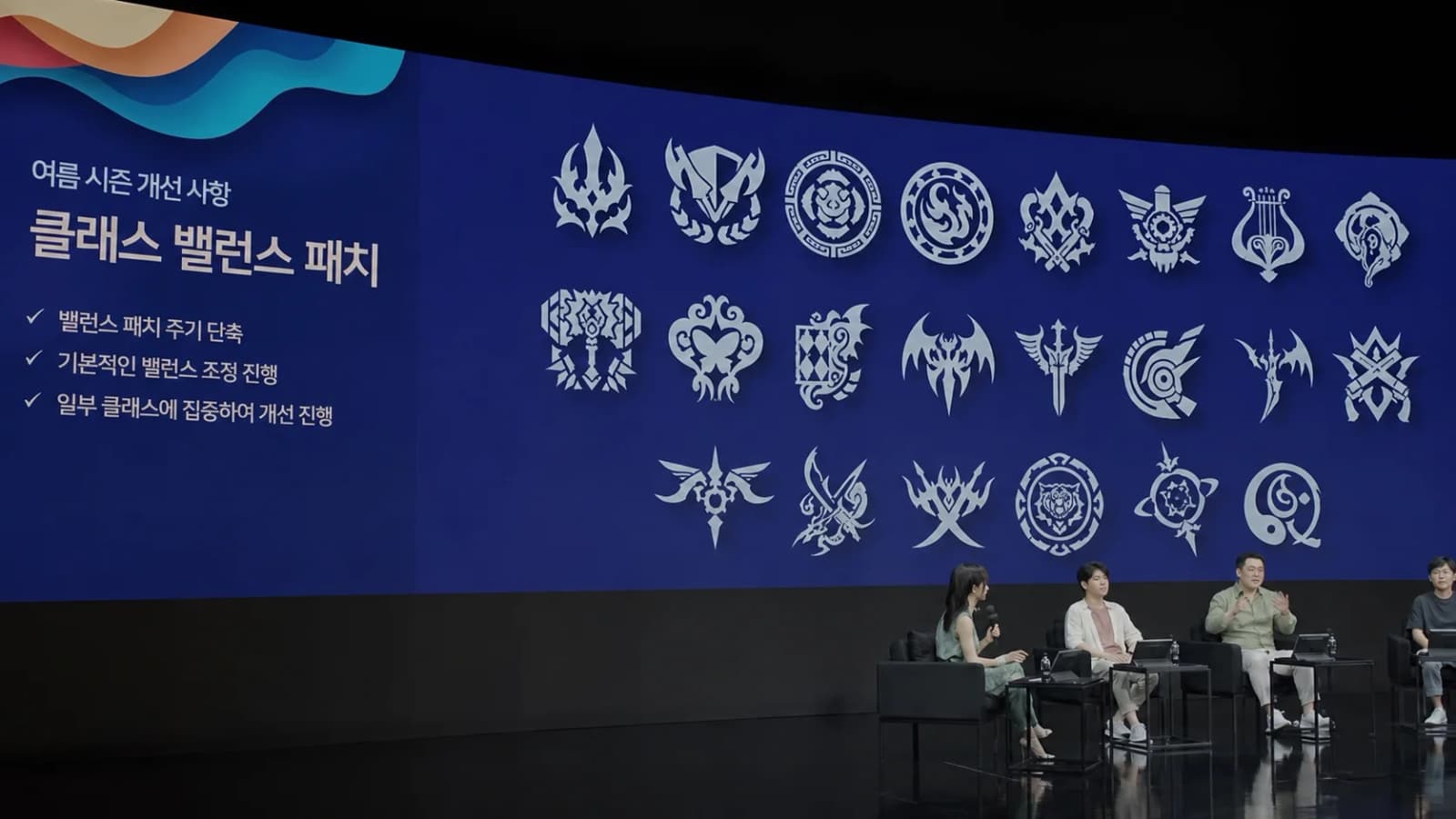

Korean raid-design commentary · About these guides
Class balance is more than a skill’s damage coefficient. Boss movement, available attack time, identity generation during mechanics, and Front or Back Attack access can change how effectively the same character performs.
The Korean source argues that encounters demanding similar uptime can repeatedly favor the same strengths. Its comparison with older raids is an interpretation of encounter design, rather than a measured historical class ranking.
Why the Debate Extends Beyond Damage Numbers
The concern is that class structure can sometimes matter more to a result than additional player improvement.
Practice improves prediction, accuracy, meter preparation, and recovery after mechanics. However, it cannot remove every limitation imposed by cooldowns, animations, or positional requirements.
Important variables include:
- Main-skill cooldowns and gaps between rotations.
- Identity-meter generation.
- The ability to fit damage into a short opening.
- Front Attack and Back Attack access.
- How reliably major skills hit a moving boss.
- Cast times, startup, and recovery animations.
- How quickly the rotation recovers after a mechanic.
- Cooldown gems and Swiftness breakpoints.
If these differences become large, a well-played character may struggle to match a more favorable kit in a particular encounter. The source calls this a debate about built-in class advantages; it does not provide population data proving that player skill no longer matters.
Structural Differences Practice Cannot Fully Remove

Two kits with similar theoretical damage can deliver different results when one lands its skills more reliably in the actual raid.
A burst build needs to finish its important sequence before the opening closes. A sustained build needs enough repeated attack opportunities to avoid losing ready cooldowns.
Those constraints create different strengths:
Burst Builds
Burst builds concentrate identity resources and main skills into a relatively short sequence.
Clear, predictable openings can reward that approach. Sudden movement or damage reduction can spoil a prepared sequence, and missing one major skill may have an outsized effect.
Sustained-Damage Builds
Sustained builds accumulate damage through repeated casts and shorter cooldowns.
They can benefit from long attack windows, but frequent forced downtime can waste skills that are already ready to use.
Neither style is automatically better. Its value depends on when the encounter permits damage, how the boss behaves, and how the group advances mechanics.
How Encounter Conditions Change Performance
Even similarly equipped characters can face different practical constraints:
| Build Characteristic | Helpful Conditions | Difficult Conditions |
|---|---|---|
| Burst-focused | Short, predictable damage windows. | Sudden movement or unexpected damage reduction. |
| Sustained damage | Long stretches of usable attack time. | Frequent mechanics that prevent attacking. |
| Back Attack focus | A boss with a stable facing direction. | Rapid turns or a rear position blocked by a wall. |
| Front Attack focus | A safe, accessible front position. | Dangerous frontal attacks or repeated repositioning. |
| Less position-dependent damage | Encounters requiring flexible movement. | A low baseline payoff despite positional freedom. |
| Identity dependence | A way to prepare meter before the next opening. | Meter resets or no available target for generation. |
Varied encounters can distribute advantages across kits. Repeatedly asking for the same strengths can instead favor the same builds across several gates.
What Older Encounters Illustrate
The source uses older raids to illustrate different combinations of damage windows and mechanics, rather than claim that those eras had perfect balance.
Akkan combines mechanics, gauge management, Stagger, and attack windows. Thaemine adds demanding patterns, longer engagements, and Clash execution where applicable. Those demands affect how positional and meter-dependent skills fit into the fight.
Ivory Tower also asks for different forms of Stagger, Destruction, grab responses, and encounter-specific mechanics. Utility can matter alongside raw damage.
| Content | Example Variables | Practical Implications |
|---|---|---|
| Akkan | Gauge management, Stagger, and mechanic transitions. | Preparation and reliable mechanic execution matter. |
| Ivory Tower | Stagger, Destruction, and grab-related mechanics. | Utility and timely responses can be valuable. |
| Thaemine | Long engagements, Clashes, and demanding patterns. | Encounter knowledge and positioning affect uptime. |
| Aegir | Repeated attack sequences and usable damage time. | Stable rotations and skill accuracy matter. |
| Serca, the Witch of Pain | Gate-specific patterns and repeated execution demands. | Kit reliability can become especially visible. |
| Horizon Cathedral | A four-player Abyssal Dungeon with stages and two gates. | Individual execution and party composition matter. |
When gates test different abilities, one kit is less likely to enjoy exactly the same advantage everywhere. This is a design principle, not proof of an existing universal balance outcome.
Aegir, Serca, and Horizon Cathedral Are Separate Content
Do not treat Aegir and Serca as two names for the same raid.
Aegir appears in Kazeros Raid Act 1. Serca is a separate Shadow Raid, while Horizon Cathedral is a four-player Abyssal Dungeon.
Their formats and mechanics differ. The article compares how each exposes reliability and uptime, rather than claiming they share identical party sizes, gates, or patterns.
When Consistent Uptime Becomes a Major Advantage
A build that can repeatedly land ready skills can benefit from frequent small openings between patterns.
Long setup or gaps between cycles may be harder to accommodate. For example, Igniter Sorceress depends on landing important skills during its burst window; movement or damage reduction can reduce its payoff.
Lunar Voice Reaper links identity generation with its major attacks, while Loyal Companion Sharpshooter depends on repeated skill execution. Their actual results still depend on the selected setup and encounter.
These examples do not establish that either class is always weak in sustained encounters. Patch version, passives, skill gems, party synergy, and the group’s damage speed all affect the result.
Positional Risk and Reward
Front and Back Attack builds must manage the boss’s facing. A quick turn or a wall can make their required angle difficult to reach safely.
The design question is whether successful positional play receives an appropriate payoff. If a less position-dependent build performs similarly while facing fewer constraints, positional effort can feel insufficiently rewarded.
A stable-facing boss can create the opposite advantage. Balance therefore depends on encounter movement as well as a character’s theoretical damage.
Why Coefficient Changes Do Not Solve Everything
Raising or lowering damage can change results immediately, but may leave the underlying execution problem intact.
Examples include:
- Very long main-skill casts.
- Ground effects that a moving boss easily leaves.
- Large losses after failed identity generation.
- Rotations that require expensive gem or Swiftness breakpoints to function.
- Large damage losses when positional requirements fail.
- Slow recovery after mechanic transitions.
- A limited payoff for demanding execution.
A numerical buff may compensate for one encounter while leaving the same frustration in another. Skill behavior and identity management deserve separate consideration.
Possible Design Directions
Vary the Demands Across Gates
Combine short burst openings, longer damage phases, Stagger, Destruction, positioning, and individual mechanics in different ways instead of making every gate test the same uptime pattern.
That can give different kit strengths meaningful opportunities without requiring every class to play identically.
Evaluate Execution Difficulty and Payoff Together
Consider the risks created by positioning, animation commitment, and complex resource cycles when evaluating damage rewards.
Training-dummy ceilings alone are insufficient. Compare both ideal execution and the outcomes players can consistently achieve in real encounters.
Avoid Giving Every Class the Same Burst Conversion
Compressing meter generation and damage into a short window can be powerful, but applying the same solution everywhere risks flattening class identity.
A kit that already has strong sustained output could gain too much if all burst limitations disappear. Preserving distinct strengths can be preferable to removing every weakness.
Use Encounter-Level Evidence
Useful evidence would include:
- Average skill hit rate by gate.
- Completed identity cycles.
- Successful Front Attack and Back Attack rates.
- Damage lost to missed main skills.
- Rotation recovery time around mechanics.
- Performance differences across experience levels.
- The effects of party composition and raid damage speed.
Such data could help distinguish strong baseline tuning from a kit that happens to fit one encounter especially well. This article does not claim to have collected those measurements.
Raid Design FAQ
Why Does the Source Think Balance Complaints Have Increased?
It argues that similar encounter demands expose the same kit differences repeatedly, while fast information sharing makes those differences more visible. This is an explanation to investigate, rather than a measured account of all players’ opinions.
Can Practice Overcome a Class Disadvantage?
Practice improves prediction, hit rate, resource management, and survival. It may not erase a large baseline or reliability gap, but the size of that gap requires actual evidence.
What Helps in a Sustained-Damage Encounter?
Shorter cooldowns, reliable hits, and quick responses to movement can help. Frequent forced downtime can still hurt a sustained build by removing opportunities to spend ready skills.
Are Positional Builds Always at a Disadvantage?
No. Stable boss facing can reward them, while rapid turns and inaccessible angles can reduce their practical output. Evaluate the actual gate and patch instead of assuming one answer applies to every raid.