

Roblox Don’t Splash (DONT SPLASH) is a horror obstacle game where the sound of splashing water turns into danger. Cross the platform on the water and head to the exit, but if you trip and make the sound of water, a monster will approach. The first key to remember is not to run fast all the time, but to check the next foothold and, when necessary, make noise somewhere else to secure space to move
What you should pay attention to in this game is the connection. Jumping well and avoiding monsters are not separate tasks. Movement mistakes lead to chase, and items give you time to make up for those mistakes or cross difficult sections. If you understand this structure rather than just looking at the monster's appearance, it becomes much clearer what kind of fun you can expect and what you should learn first.
What is Don’t Splash, and where can you find it?
Don’t Splash is a game that runs within Roblox, and the creator on the official page is Bacon Theory. The English name is DONT SPLASH and the experience identification number is 119958473240233. When searching, it is best to check the title and creator together to avoid being mixed up with works with similar names. This identifying information is more reliable than the update text attached to the name.
The official classification is the Obby & Platformer series, which goes through obstacle courses. If you are unfamiliar with ‘obby’, think of it as a game where you run between platforms and read the timing of obstacles. By adding a monster that reacts to the sound of water, a failed jump can lead to a chase. The admission price is listed as 0 Robux on the official page, but this does not mean that all gear or upgrades in the game are free.
The background is an indoor swimming pool with tiles, pillars, and water. The creators explain that they were inspired by the eerie atmosphere of Poolrooms and House of the Locust. It's a familiar swimming pool, but the fact that there are no people and similar spaces continue to create anxiety. Rather than the fear of not being able to see anything because it's dark, it's closer to being nervous about falling into the water even though you can see the place you need to cross.
Keep your route separate from your noise distractions
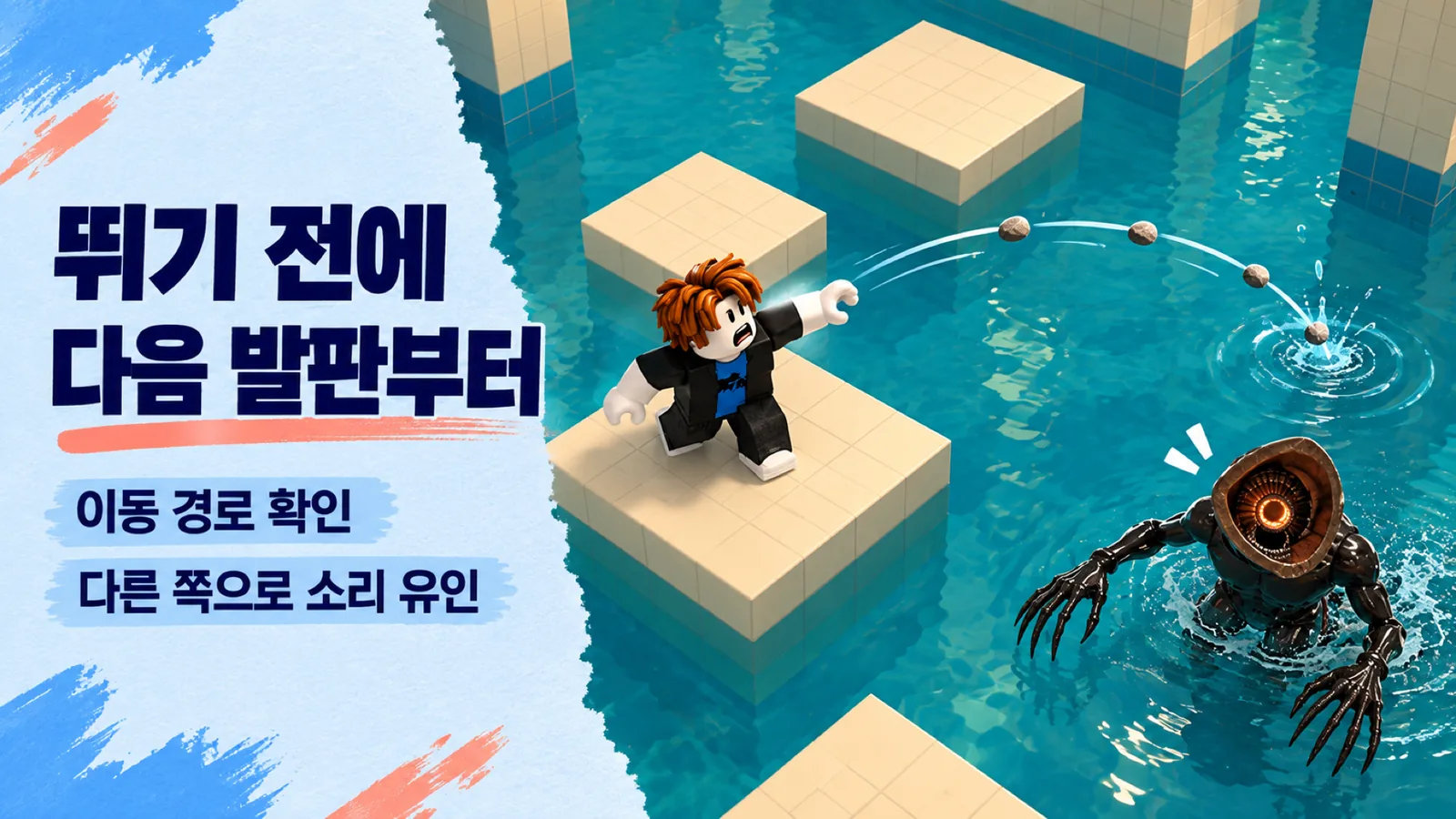
The basic danger signal is the sound it makes when it touches water. You can use dry platforms to move around and use tools like pebbles to create water sounds in different locations to distract the monster. The sound mentioned here is the sound of water in the game, so there is no need to understand that in reality, it is a game detected by a microphone.
What is important is not the fact that you threw the object, but where you threw it. If you lure it right next to the platform it will land on next, you are gathering danger in the direction it wants to go. The logical order is to first decide the next movement section from a safe foothold, make a sound on a side away from the path, and then check the monster's reaction. If you rush to lure and move at once, it's easy to miss the monster's location and landing point.
Look also at the connection between the arrow on the pillar and the footrest. It's not enough to just climb on the one platform in front of you; you can also avoid stopping in the middle if you know the direction leading to the next platform. Especially as the space expands, the direction toward the exit may not match the path you can immediately cross.
If you have difficulty judging the jump distance, it is worth checking out the third-person switching function in the starting area. Viewing the character and the platform together can help you estimate where you will land. Changing the viewpoint itself is not the right answer, but it means choosing whichever you need at the moment: a wide view of the monster or a comfortable view of what is beneath your feet.
Where to wait on sinking and moving platforms
Even on the same water, the judgment required varies depending on how the platform operates. ‘Stop and think’, which works on fixed platforms, cannot be applied to all sections. Waiting time itself becomes dangerous when standing on a platform that sinks or pushes the character away.
| Interval Type | Things to look at first | Important judgment when moving |
|---|---|---|
| Sinking Foothold | Steps that go down when stepped on and steps that allow you to wait | Decide the next landing point before departure |
| Rotating Bridge | The moment the end of the bridge approaches the next road | Choose the timing to cross by looking at the direction of rotation |
| Mobile Platform | Gap between moving direction and footrest | Predict your position when you land compared to your current position |
| Pushing Step | Floor arrow and direction the character is pushed | Do not stand for long and prepare for the next move |
| Memory Bridge | Safety tile illuminated to reveal | Check the visible pattern and move while remembering it |
| Moving Wall | Wall coming direction and open passageway | Find empty passages without sticking to blocked paths |
If hasty jumping is a problem on a rotating bridge or moving platform, late judgment is a problem on a sinking platform. So, a commonly helpful habit is not ‘stopping anywhere’ but ‘seeing enough where you can stop’. If you read the next section and start from a point where you can stand stably, you will be less likely to change direction suddenly on moving platforms.
Memory bridges require another kind of attention. Since you have to remember the safe route by looking at the light-up tiles, it is difficult to learn the route just by blindly following others. If you missed something, it would be better to double-check the markings from a safe waiting location. Rather than memorizing the left and right order of the road someone else crossed, it is more important to read the pattern shown to you.
The cause of mistakes is different for each obstacle, so the explanation that ‘you just need to jump better’ is not enough. It will be more helpful for your next attempt to figure out what you missed from the point you fell. The behavior that needs to be corrected varies depending on whether it is a problem with distance calculation, a waiting position problem, or a missing foothold operation rule.
Choose items by their role: distraction, movement, or rescue
It is easier to understand gear if you divide it into tools to attract by making a loud sound, tools to temporarily stop the monster's behavior, and tools to rescue teammates. Just because you have a lot of money doesn't mean you will be safe, and it is only effective if you choose the right tool for the current situation.
Pebbles, bottles, and wind-up toys are for attracting. Pebbles create water sounds in different locations, and bottles serve to draw attention to larger splashes. Wind-up toys move in the water and make sounds. In the beginning, it is better to learn how the monster reacts when you throw a pebble. If you increase the type of gear without knowing this relationship, you may be confused about what to use when you are in a hurry.
If you look at the flare as simply a device that lights up a dark place, it is easy to miss its purpose. Its role is to briefly stun monsters, so treating it in the same way as a decoy tool may not produce the results you expect. Attracting changes where the monster is heading, while stunning briefly halts its movement. You need to decide where to move while the effect is taking effect so you can utilize the time you have.
The rescue rope is a tool to pull up fallen team members. It is difficult to use if the distance is too far, and there is a limit to the number of uses for each room, so it is difficult to see it as an all-purpose insurance that can be used repeatedly. If you only look at your teammates below and the rescuer also falls into the water, the situation will get worse, so you need to check your own footing and the location of the monster.
It is better to select upgrades based on these roles. If the decoy point is too close and you have trouble, look at the throw distance. If you fail to rescue because you can't reach your teammate, look at the rope reach distance. The important criterion here is not whether the gear is expensive, but whether it reduces the cause of repeated failure. Please check the description on the purchase screen for price, effect values, and usage restrictions.
Leave a safe position for the player performing a rescue
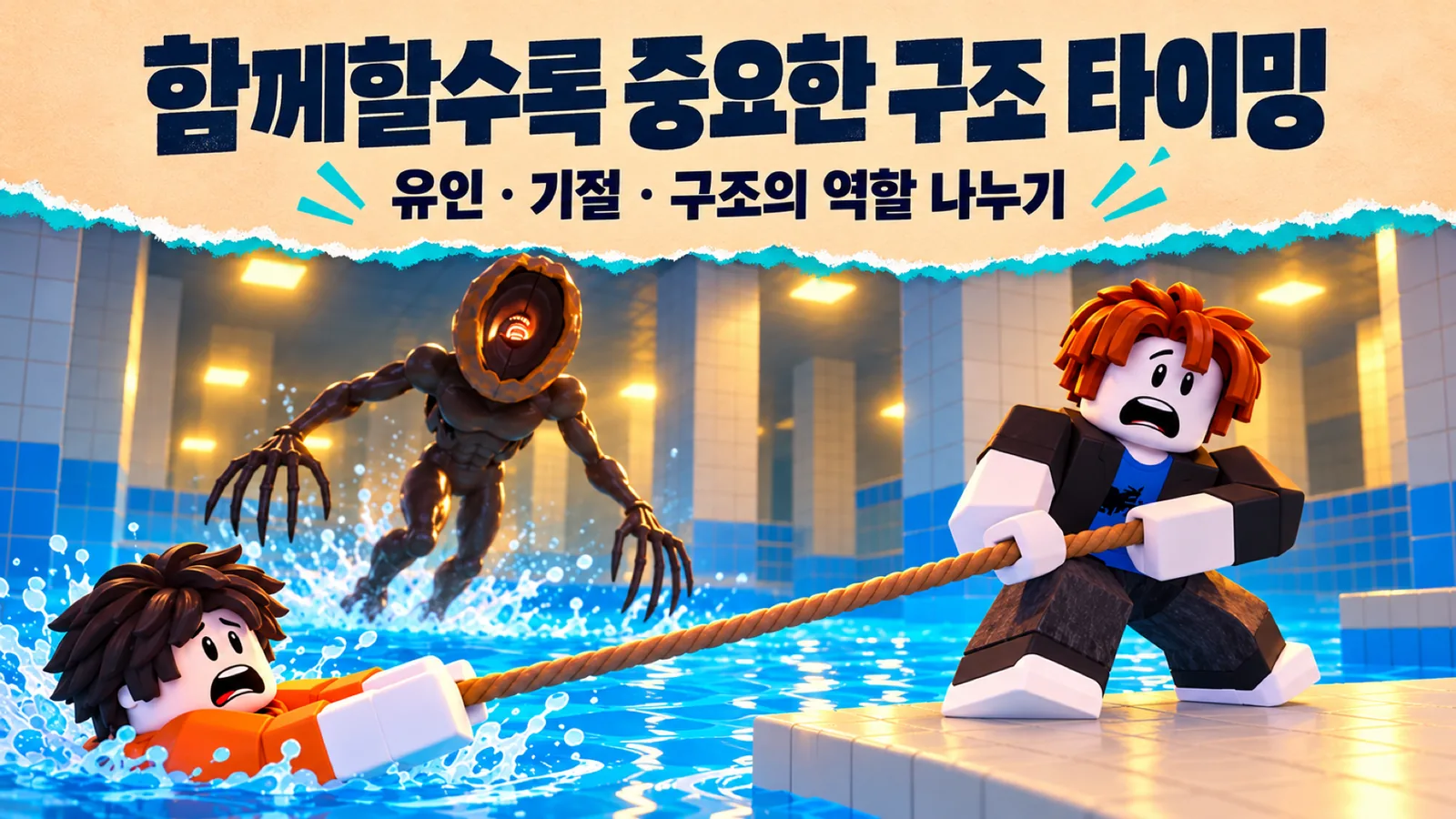
The advantage of working together is that when someone makes a mistake, the other person can respond. You can split the action, with one person using sound to lure the monster away while the other crosses, or using a stun tool and rope when a teammate is in danger. The fun of cooperation arises in moments like these rather than doing the same jump at the same time.
However, if several people move close together, it becomes difficult to secure each person's landing position and waiting space. Rather than following right behind the person in front without knowing where they will stop, it would be better for the person who crossed first to inform them of the nature of the next step and for the person following to keep a gap. Just sharing information briefly, such as ‘It’s a sinking place, let’s move on right away’ or ‘You can wait here’ can play a role.
When a teammate falls in, it is important to find a position to rescue them first rather than blindly approaching them. The person who will throw the bait will turn the monster in the other direction, and the person who will use the rope will have a stable footing within reach. It doesn't automatically become easier if you play with a friend, but cooperation is helpful when each other's movement and tool use are aligned.
Check camera objectives at locked exits
In the locked exit section, you are given the task of finding four numbers on a pillar and filming them with a camera. It's not just about seeing numbers on the screen; you have to check whether the goal is registered by shooting. So, it is better to look at the pillars and goal marks in your section rather than just taking someone else's escape code.
In cooperative situations, you will also see how the numbers taken by your teammates are displayed together. Rather than repeatedly searching for already registered numbers, you can reduce movement by dividing up the remaining goals. Since the puzzle requires you to keep moving on the water, it's important not to rush until it's the end.
Increasing the difficulty increases the burden, such as longer travel sections, and the number of separately set monsters also affects the intensity of the challenge. However, you don't need to expect completely new puzzles to appear in every section just because the level of difficulty is high. It's better to understand it as a challenge to apply the same rules over a longer path and with many threats. For difficulty unlock conditions and room configuration, please prioritize the information in the entrance menu.
The appeal lies in recovering from mistakes
Don’t Splash is a good fit for anyone looking for a game with horror elements mixed in with an obstacle course. It requires both concentration to read the next step and judgment to respond when the sound of water is heard. On the other hand, if you are expecting a horror game in which you follow the story and continuously discover new scenes, it is worth considering that there is a large proportion of repeatedly crossing platforms and learning the path.
The more important thing to look at when judging this game is not how much the monster surprises you, but whether your next choice can be different after failing. When the actions of anticipating the next step, changing direction, and positioning yourself to rescue a teammate have meaning, it becomes more fun than just chasing. Rather than having all the gear, the goal for your first challenge should be to distinguish where to wait and where to move
