
The Modern Warfare reboot follows the 2019 game, Modern Warfare II, III, and 4. Establish this order first. Mixing it with the original games can produce false connections about character deaths and betrayals.
The central question is less how capable Price is than how far preventing a threat can justify his methods. Covert operations, leaked weapons, and command cover-ups accumulate until even someone trying to protect his friends moves beyond control. In that context, the Korean front in 4 becomes more than an added battlefield.
This article contains major twists and ending spoilers for the first three reboot games, plus spoilers about the opening and character relationships in 4.
Separate the original timeline from the reboot
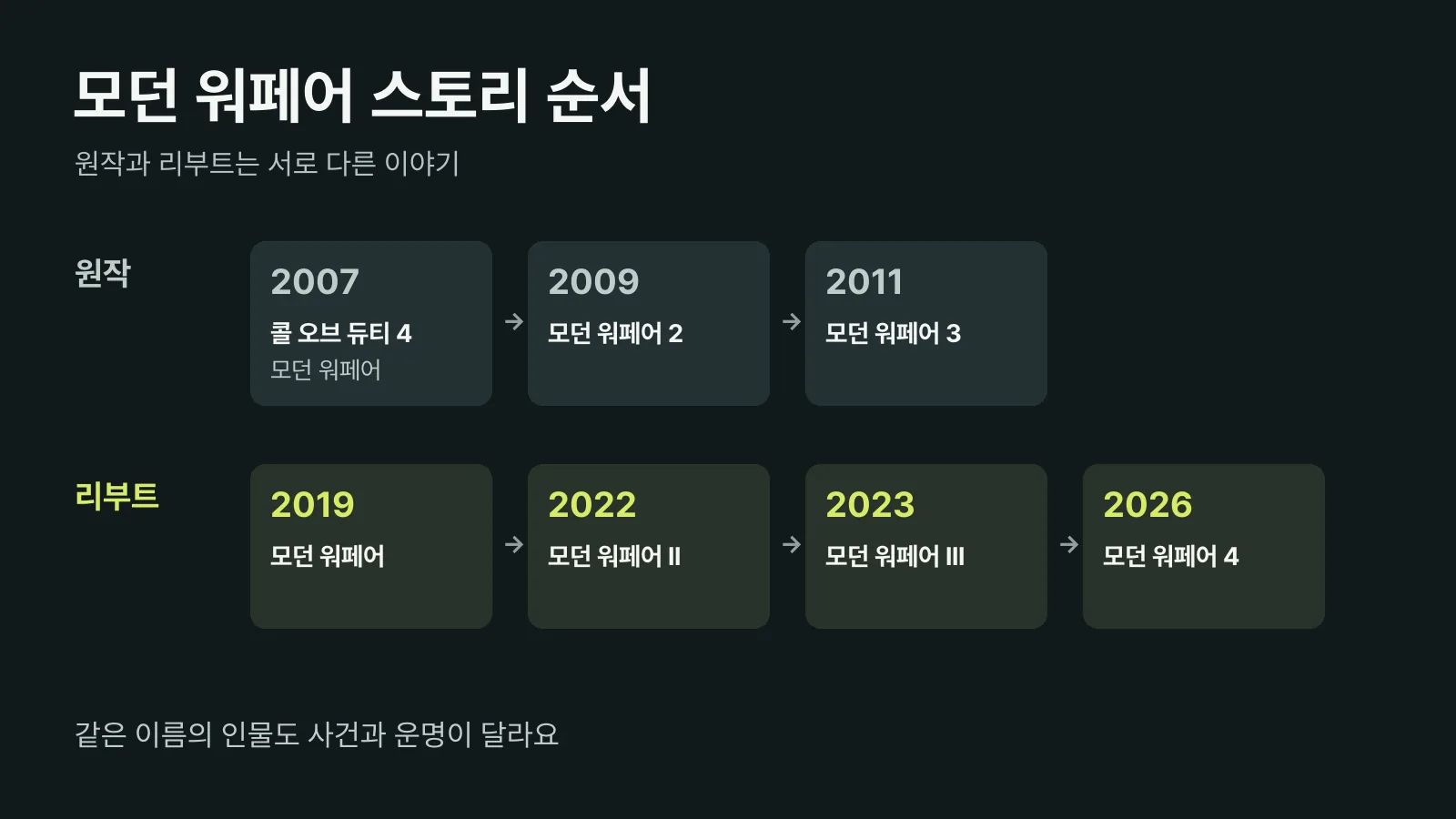
The two stories share major character names. Meeting Price, Soap, and Ghost again does not mean the original games' events carry over.
| Timeline | Story order |
|---|---|
| Original | Call of Duty 4: Modern Warfare (2007) → Modern Warfare 2 (2009) → Modern Warfare 3 (2011) |
| Reboot | Modern Warfare (2019) → Modern Warfare II (2022) → Modern Warfare III (2023) → Modern Warfare 4 (2026) |
Call of Duty 4, the first original game, and the reboot sequel Modern Warfare 4 are different games. The first numeral belongs to the main Call of Duty series; the second identifies a later entry in the new Modern Warfare story.
The 2019 game is a new starting point using familiar characters and modern warfare, not a continuation after the original third game. A remaster is also different: updating an original game is not the same as rebooting its story.
For newcomers, release order lets trust and betrayal develop naturally. Learning a twist in isolation may tell you who betrayed whom without showing what the betrayal cost.
The question posed by the 2019 chemical weapons
The opening reboot connects stolen chemical weapons, terrorism in London, and conflict in fictional Urzikstan. Price and Gaz's counterterrorism operations run alongside CIA operative Alex and resistance commander Farah's story.
Farah is more than a local ally assisting Western soldiers. She must protect her people between Barkov's occupation and Al-Qatala's threat. Outside powers focus on recovering dangerous weapons, while she faces an ongoing life under occupation and violence. Their aims overlap without being identical.
Her brother Hadir exposes that difference sharply. Revealing him as the chemical weapons thief forces a distinction between resisting occupation and the means used. Having suffered does not confer a right to use indiscriminate weapons.
Farah killing Barkov and destroying the facility can be read through the same distinction: preserving legitimate resistance requires refusing the enemy's methods. The first game's weight lies partly in which means are rejected, beyond who wins.
Price then pursues the formation of Task Force 141 around Gaz, Soap, and Ghost. The familiar team is built through this crisis rather than appearing fully formed from the beginning.
Why does Shepherd betray the team in Modern Warfare II?
In II, 141 tracks Hassan Zyani and missing American missiles, cooperating with Alejandro's Los Vaqueros in Mexico. Following the weapons leads into a problem their own chain of command wants hidden.
Shepherd secretly transported missiles with Graves's Shadow Company. Konni stole them, and the threat continued through Hassan and Valeria's Las Almas cartel. Shepherd chose concealment over accountability, making 141 and their local allies targets for elimination.
The motive is more specific than simple ambition. Bypassing official procedures created the initial failure; covering it up created a greater wrong. The response to a failed covert operation becomes more dangerous than the operation itself.
Soap and Ghost's dependence on each other after Graves turns against them matters for the same reason. When orders and loyalty to nearby comrades diverge, trust must have another basis. Their teamwork grows from needing to survive together, beyond memorable dialogue.
They stop the remaining missile attack in Chicago and eliminate Hassan. The immediate crisis ends, but the system that lost the weapons and concealed the truth remains unresolved, linking the story to the next threat.
Shepherd's wrongdoing does not automatically make every action by 141 correct. Keeping that distinction lets us judge Price's later methods by the same standard.
Soap's death changes Price's position
Modern Warfare III brings Makarov and Konni to the forefront. Makarov uses attacks and misattributed blame to provoke international conflict. Stopping an enemy on the ground does not necessarily control how an incident is reported or exploited.
The decisive loss is Soap's death. While disarming a bomb, he tries to stop Makarov attacking Price and is killed. Price later finds and shoots Shepherd, moving beyond the protection of the institution he served.
Soap's death deserves more than treatment as fuel for the protagonist's anger. A relationship built within 141 is genuinely severed, and survivors must make decisions with that loss. Without meaningful consequences for later choices and relationships, the scene risks becoming shock alone. What follows the death matters as much as the moment itself.
Shepherd being responsible and Price having authority to execute him are separate judgments. Sympathy for grief does not fully justify the response. III ends with reasons both to support Price and to be wary of him.
Why the Korean front in Modern Warfare 4 matters
The fourth game intercuts war in South Korea after a North Korean invasion with Price's pursuit as a fugitive. Private Park Hyun-joon and South Korean and US Marines fight on a collapsing front, while Price allies with former enemy Valeria. This invasion and Korean setting belong to the game's fictional war.
Park's viewpoint can show the distance between those directing war and those enduring it. Price seeks the forces behind the threat; soldiers on the ground need communications, casualty evacuation, and survival with the person beside them. Placing small frontline goals beside covert operations changes the meaning of success.
Valeria's cooperation is more than an unexpected pairing. Someone involved in dangerous weapons trafficking in II now helps Price. Access and information motivate the alliance, reviving the first game's question of how much compromise an objective permits.
Conflict with former allies trying to stop Price makes his crossing of the line visible through relationships. Familiarity makes us want to trust him, but past service does not automatically excuse present danger. His story becomes more complicated than a powerful hero's pursuit.
Korea's portrayal should meet the same standard. Korean signs and recognizable food alone do not make a setting convincing. Developers describe reviewing dialogue and cultural details, but the key question is whether Korean soldiers have their own judgments and relationships rather than serving as scenery for someone else's revenge.
Understand 141 through the object of its loyalty
Task Force 141 is the special-operations team centered on Price, Soap, Ghost, and Gaz, with Laswell connecting intelligence and operations. Farah and Alejandro are partners responsible for their own people and forces. Separate who commands whom from whom each person wants to protect to clarify the relationships.
Loyalty to a unit, trust in a commander, and responsibility to comrades usually appear aligned. Shepherd's cover-up and Price's departure put them in conflict. Characters may disagree on whether refusing an order abandons a friend or prevents a greater wrong.
Hadir, Shepherd, and Price are not interchangeable: their circumstances, aims, and responsibilities differ. Yet all can be asked who controls their methods when they believe they are preventing a larger threat. Relaxing that standard only for the protagonist removes an important tension.
The reboot becomes more interesting when we follow how characters face consequences alongside the order in which enemies fall. Beyond understanding why Price chose a course, ask whom it endangered. That is a useful thread connecting the first game through the fourth.
